
Agentic AI is the biggest leap in real estate technology since the internet. And most advisors aren’t using it yet.
A note on language: I’m calling us “advisors” in this article, not “agents.” Not because I’m precious about job titles. Because “agent” now means software that executes tasks autonomously. You’re not software. You’re an advisor. The distinction matters more than you think.
Not because the tech is bad (it’s genuinely incredible). AI that thinks, adapts, and acts autonomously? That’s not a better chatbot. That’s a digital team member. The advisors who deploy this right have an unfair advantage for the next decade.
But here’s what the hype machine won’t tell you: Gartner reports 40% of agentic AI projects are being canceled. Not because the tech doesn’t work (it does). But because companies point it at the wrong things and watch their business value collapse.
The gurus are already lining up to sell you “fully automated follow-up” and “AI that handles your relationships while you sleep.” Same lazy playbook, shinier packaging. And 40% of the advisors who buy that pitch are starting over within a year.
The bar is low. Most advisors in your market haven’t touched this stuff. Just starting puts you ahead. And the advisors using it now, even badly, are building judgment. Judgment compounds. Six months of messy experiments teaches you more than any course ever will.
The other 60%? They’re using agentic AI to amplify their human strengths and build businesses their competitors can’t touch.
This article is about being in that 60%.
What Is Agentic AI? (And Why Everyone’s Suddenly Hyping It)
Agentic AI: AI systems that independently analyze, make decisions, and act autonomously to complete tasks. No scripts. No constant human input. It adapts to changing conditions, learns from feedback, and acts proactively toward defined goals.
Traditional AI is a calculator waiting for you to press buttons. Agentic AI is a digital executive who sees a problem, researches solutions, makes decisions, and takes action, all without you.
The distinction matters. Traditional automation follows decision trees: if this happens, do that. Agentic AI uses goal-oriented reasoning: here’s the outcome I need, now let me figure out the path to get there (even if conditions change mid-process). This isn’t faster automation. It’s adaptive automation that handles complexity without breaking.
Why now?
The global agentic AI market hit $5.25 billion in 2024. Projected to reach $199.05 billion by 2034: a 43.84% growth rate. Massive money means massive hype and vendors scrambling to sell you tools before you understand what you need (or don’t).
Gartner reports 40% of enterprise applications now embed AI agents, up from less than 5% in 2025. Mainstream adoption isn’t coming. It’s here.
But here’s what nobody’s shouting: 40% of those agentic AI projects are failing.
Why?
Research on AI deployment shows most projects are early-stage experiments driven by hype and misapplied use cases. Companies spend money on automation without thinking through what actually needs automating, or what the human cost will be when they automate the wrong things.
Real estate advisors? Making the exact same mistake.
What’s Happening Right Now
Here’s the reality on the ground.
Right now: 40% of enterprise applications embed AI agents. Real estate brokerages are part of this wave; 87% already use AI daily (WAV Group). The shift from novelty to infrastructure already happened.
Gartner’s projection: 40% of those agentic AI projects get canceled. Escalating costs, unclear business value, inadequate risk controls: companies automate without strategy and pull the plug.
By 2028: 15% of day-to-day work decisions will be made autonomously through agentic AI (Gartner), up from 0% in 2024. 33% of enterprise software will include agentic AI, up from less than 1% in 2024.
The catch?
Those numbers reflect successful implementations. The 40% that fail? Those are the companies and advisors who automated relationships instead of amplifying them.
The “Agent Washing” Scam
“Agent washing”: vendors rebranding chatbots and RPA tools as agentic AI without delivering actual autonomous capabilities. Only 130 vendors worldwide offer genuine agentic AI products (Gartner).
That CRM tool promising “agentic AI follow-up”? Probably just a chatbot with a fresh coat of marketing.
If a vendor can’t explain how their system adapts to changing conditions, learns from feedback, and acts autonomously toward goals, it’s not agentic AI. It’s automation with a glow-up.
Agentic AI vs Traditional Automation (What’s Different)
Traditional automation follows rules. If X happens, do Y. Powerful for repetitive tasks, rigid everywhere else. Change the conditions? The automation breaks.
Agentic AI is goal-driven. You tell it the outcome you want, and it figures out how to get there, adapting when conditions change, learning from feedback, making real-time decisions.
Example: Traditional automation sends an email every Tuesday at 9 AM. Your sphere gets a market update: same time, same message, regardless of context.
Agentic AI reads your calendar, analyzes email response patterns, checks relationship history, and decides whether to send, when to send, and what to send. Contact just closed on a house last week? No “buy now” email. Someone hasn’t opened emails in six months? Triggers a personal call reminder instead.
That’s the difference.
Real Estate Applications
Where does agentic AI actually add value? The early results are in.
Lead management: Qualifies leads based on intent signals: website behavior, email engagement, search patterns. Prioritizes who needs immediate attention vs who’s in research mode.
Scheduling: Coordinates showings across multiple parties: traffic patterns, client preferences, advisor availability, property access. Automatically adjusts when someone cancels.
Property research: Autonomous market analysis. Pulls comps, analyzes trends, identifies pricing opportunities, flags red flags, all without you asking for each data point.
CRM enrichment: Auto-updates contact records based on external data: property sales in your area, job changes, life events. Database stays current without manual entry.
Research on multi-agent orchestration shows 45% reduction in process hand-offs and 3x faster decisions (IBM). Most businesses see 200-400% ROI within 12-24 months.
But here’s what that research doesn’t tell you: Those gains come from automating logistics and data processing, not client relationships. The ROI comes from eliminating bottlenecks in operational workflows (scheduling, data entry, research). Apply the same logic to relationship management? The ROI collapses. You can’t measure relationship depth in percentage gains. Automating trust-building conversations doesn’t speed up sales cycles. It kills them.
What TO Automate vs What NOT To Automate (The Framework)
The industry says “embrace AI.” Correct, but incomplete.
Full truth? Embrace AI to amplify your human work, not avoid it.
Here’s how to decide what to hand off to AI and what to keep human. Five questions before automating anything.
1. Does it require trust?
If the task involves building or maintaining trust, don’t automate it. Trust is built in personal interactions: calls, face-to-face conversations, showing up when it matters. An AI-generated “checking in” message doesn’t build trust. It broadcasts that you couldn’t be bothered to pick up the phone.
2. Does it require judgment?
AI analyzes data. It can’t apply lived experience, read emotional context, or make judgment calls based on relationship history.
Years of experience create competitive advantage here. You know some clients need direct advice while others need to discover the answer themselves. You know when someone’s “thinking about it” means they’re genuinely weighing options, and when it’s a soft no. AI doesn’t have that pattern recognition. Never will.
If the task requires “knowing the person” to do it right, keep it human.
3. Does it contain your personality or voice?
Your voice is part of your brand. AI can mimic tone, but it can’t replicate the quirks, the humor, the references that make your communication distinctly yours. If personality matters, don’t outsource it.
4. Would you do it differently based on who you’re talking to?
The relationship test. If you’d handle this differently for your top advocate vs a brand new lead, automation strips away that personalization. Keep it human.
5. Does it strengthen or weaken the relationship?
The ultimate test.
After you automate this, is the relationship deeper or shallower? If automation makes the interaction feel transactional instead of personal, don’t do it.
What TO Automate vs What NOT To Automate
DO AutomateDON’T AutomateCRM reminders (AI tells you who to call, you make the call)Follow-up calls with Advocates or Fans (your raving fans: call them personally or destroy the relationship)Market research and comp analysis (AI pulls data, you interpret and apply)Personalized messages to your sphere (auto-flow for visibility is fine, personal check-ins stay personal)Scheduling coordination (AI handles logistics, you show up)Negotiation conversations (AI preps you with data, but it can’t read the room or know when to push vs back off)Lead qualification (AI scores intent, you decide who gets personal attention)Emotional or complex client situations (buying/selling homes is emotional; AI has no place in conversations where someone’s scared or overwhelmed)Property research (AI compiles info, runs numbers, you advise the client)Any communication where relationship depth matters (if they’re in your top 50/100/200 relationships and you’re automating communication, you’re telling them they don’t matter. They’ll feel it.)Marketing content drafts (AI drafts, you edit and add personality)
Here’s the data nobody automating their follow-up wants to face: 66% of home sellers found their advisor through a referral or past use (NAR). 82% of real estate transactions come from referrals or repeat business.
You can’t get referrals from a bot.
Referrals come from trust. Trust comes from humans showing up when it matters. Every advisor I know who’s built a referral-based business did it through consistent personal contact, not automated sequences.
Automate the relationship. Automate yourself out of business.
Red Flags You’ve Automated Too Much
You can’t name 10 Advocates off the top of your head
Your referrals dropped 30%+ in the past 12 months
Your Advocates get the same touchpoints as your Zillow leads
You feel “caught up” on database but haven’t made a personal call in 3 weeks
Your clients are surprised when you call them personally
You’re spending more on AI tools than you’re saving in time
You measure success by efficiency metrics instead of relationship depth
Understanding Your Contact Ladder (And Where AI Fits)
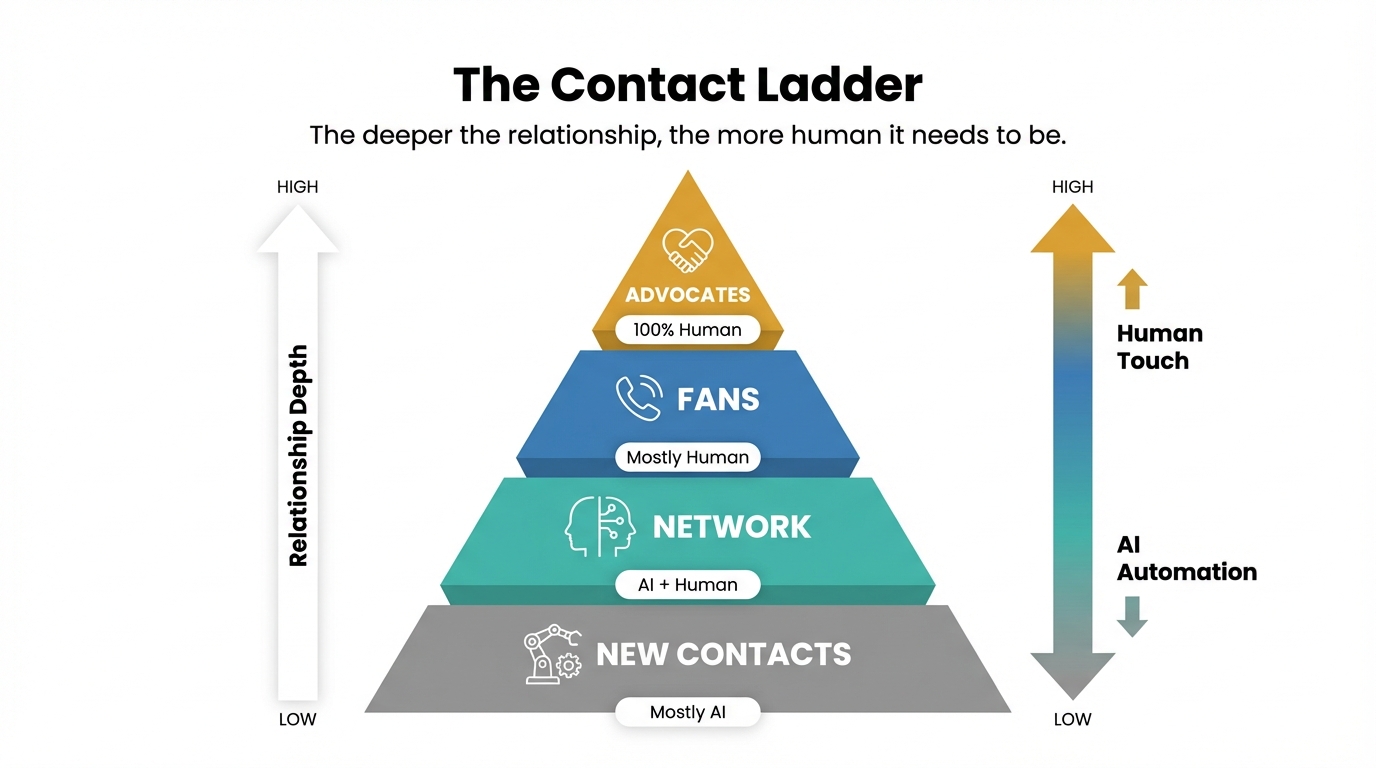
Not all relationships are equal. AI’s role changes depending on where someone sits in your Contact Ladder.
The Contact Ladder: a framework for managing relationships based on depth and engagement. This reflects how top producers actually build their business, not through volume or cold calling, but through intentional relationship management at scale.
Here’s how it works, and where agentic AI helps (and where it doesn’t).
Advocates: Your Raving Fans
People who proactively refer you. They’ve worked with you, love you, tell everyone about you. Target: 20-50 Advocates if you’ve been in the business a few years.
AI role: Remind you when to reach out personally. Track life events: anniversaries, birthdays, work changes. Tell you when to call.
Human role: Personal calls. Handwritten notes. Face-to-face time. These relationships are the foundation of your business. Treat them like it.
Do NOT automate: Communication with Advocates. If you’re sending automated emails to your raving fans, you’re weakening the exact relationships that fuel referrals.
Fans: Will Refer If Asked
These are past clients or sphere members who like you and will refer you, but they’re not as proactive as Advocates. You should have 50-100 Fans.
AI role: Automate reminders for follow-up cadence. Make sure you’re touching base quarterly, staying visible without overwhelming them.
Human role: Quarterly personal check-ins. Referral asks. Invitations to events or client appreciation gatherings.
Use AI for: Tracking when you last connected, flagging when it’s time to reach out. Don’t use AI to make the actual outreach.
Network: Your Sphere of Influence
These are people who know you but aren’t clients yet. Friends, family, former colleagues, neighbors, social connections. You should have 200-500 people in your Network if you’re maintaining it.
AI role: Auto-flow. Minimum 3 touches per month to stay visible: emails, mailers, social media. AI can handle this entirely.
Human role: Occasional personal calls. Events where you bring people together. Conversations that turn Network into Fans.
Use AI for: Automated email sequences, social media scheduling, market update mailers. This tier is about visibility, and AI can maintain visibility without you.
New Contacts: People You’re Just Meeting
Everyone starts here. You meet someone, add them to your database, and begin the relationship-building process.
AI role: 8 in 8 system automation. Eight touches in eight weeks to build familiarity and trust. AI can handle the cadence, the content, the delivery.
Human role: Initial personal outreach. Qualifying conversations. Moving them up the ladder based on engagement and relationship potential.
Use AI for: The 8 in 8 sequence. After eight weeks, evaluate: Did they engage? Move them to Network and continue auto-flow. Did they disengage? Pause outreach or remove from database.
The Key Concept: Flow Is the Lifeblood of Relationships
Staying in flow means staying visible and top-of-mind. AI maintains auto-flow: the baseline touches that keep you visible even when you’re not actively reaching out.
But live flow (personal calls, face-to-face conversations) deepens relationships and moves people up the Contact Ladder.
Use AI to remind you WHO to call. Then YOU make the call.
That’s flow.
The Skills That Matter Now (What AI Can’t Replace)
Routine interactions are being automated right now. The advisors who thrive are the ones who use that automation to double down on what AI can’t do.
Sound simple? It’s not.
The industry is bifurcating, and both sides are using AI:
Advisors who use AI to avoid work: They automate follow-up, relationships, and personal touches. Volume-based, transactional, hiding behind sequences. They’re being outcompeted by advisors who use the same tools to show up more, not less.
Advisors who use AI to amplify work: They automate admin, research, logistics, and lead qualification, then invest the saved time into deeper relationships, expert judgment, and complex negotiations. Same AI. Opposite strategy. Wildly different results.
Research on AI capabilities shows task duration doubling every seven months (METR). What took AI one hour in early 2025 takes eight hours by late 2026. AI is getting better at sustained, complex work. That’s exciting: more of your tedious admin disappears every year.
But AI isn’t getting better at being human. The gap between “can complete a task” and “can build a relationship” isn’t narrowing. It’s widening. As AI handles more complex workflows, the human elements (empathy, judgment, trust) become more valuable, not less. The advisors who recognize this use AI to free up time for more human work. The ones who use AI to avoid human work compete on price with every other automated advisor in their market.
The advisors building judgment NOW, even through messy experiments, are creating a gap their competitors can’t close with better tools later. Judgment isn’t downloadable. It’s earned.
Skills To Double Down On
1. Deep relationship building
Your Advocate list is your moat. 50 raving fans who proactively refer you? You’ve got a referral engine no amount of automation can replicate. Zero? You’re competing on efficiency alone, and that’s a race to the bottom.
I’ve watched advisors build entire careers on 30-40 strong relationships, and I’ve watched advisors with databases of 5,000+ contacts struggle because none of those relationships were deep enough to generate referrals. The number that matters isn’t database size. It’s how many people would call you first if they needed an advisor.
2. Complex problem-solving
Multi-party negotiations. Emotional situations. Deals with seven moving parts and eleven opinions. AI preps you with data, but it can’t navigate the human dynamics.
3. Local market expertise
Years of neighborhood knowledge. Which streets flood. Which schools are improving. Which developers are planning projects. AI can scrape data, but it can’t replace lived experience.
Contextual intelligence: understanding not just what the data says, but what it means in practice. You know that house priced 10% below comps isn’t a deal (it backs to the highway). You know the “hot neighborhood” everyone’s talking about floods every spring.
That pattern recognition comes from being there: seeing deals fall through, hearing client feedback after they move in. Irreplaceable.
4. Trust and emotional intelligence
Buying and selling a home is emotional, not transactional. The advisor who can read a room, sense when someone’s scared vs bluffing, show up with empathy in stressful moments: that advisor wins.
5. Strategic AI use
Knowing what to automate vs what to keep human. This is the meta-skill. Advisors who understand this framework outperform the ones who blindly adopt every new tool.
Ryan Serhant: “AI should make you like your real estate advisor more... The big advantage in AI use is having more time for advisors to provide personalized attention to clients.”
NAR’s position: “REALTORS should embrace AI as a business partner, not a competitor.”
The advisors who thrive aren’t the ones who automate the most. They’re the ones who know what NOT to automate.
The Accuracy Problem Nobody’s Talking About
Here’s the part AI vendors won’t tell you.
Research on AI search accuracy found incorrect answers to more than 60% of queries (Columbia University study testing eight AI search engines).
60%.
AI hallucinates. Makes up answers confidently. Cites sources that don’t exist. Generates plausible-sounding information that’s completely wrong.
Relay that information to a client?
You’re liable.
Real Risks for Real Estate Advisors
Fair Housing violations: AI trained on biased data can violate Fair Housing laws. If your AI tool steers clients toward or away from neighborhoods based on demographic patterns, you’re exposing yourself to legal action.
Compliance failures: Real estate is regulated. AI-generated content (especially around disclosures, financing, legal obligations) needs human oversight. AI gets it wrong and you share it? You’re responsible.
Client trust damage: 2024 example: Kelowna realtor fined for not disclosing AI-generated images in a listing. Images misrepresented the property. Client found out. Trust destroyed.
Inaccurate advice: AI doesn’t know your local market nuances. Doesn’t know which lender actually closes on time, which inspector is thorough vs sloppy, which contractor delivers vs ghosts. Using AI to advise clients without verifying? You’re gambling with your reputation.
What This Means
Don’t trust AI for legal, regulatory, or financial information. Always verify data before using it in client communication. Disclose when content is AI-generated (especially images, videos, virtual staging).
Keep human oversight on everything client-facing.
AI is a tool, not a substitute for expertise, judgment, or accountability.
This is exactly why starting now matters. Every time you catch an AI hallucination, every time you verify a comp before sharing it, you’re building judgment. That judgment compounds. The advisor who’s been checking AI output for six months spots errors the new adopter misses completely.
This content is educational and reflects industry research and observation. Real estate practices vary by state and market. Consult your broker for guidance specific to your situation. AI tools carry risk; use them with appropriate oversight and verification.
Advisor A vs Advisor B: The Reality Check
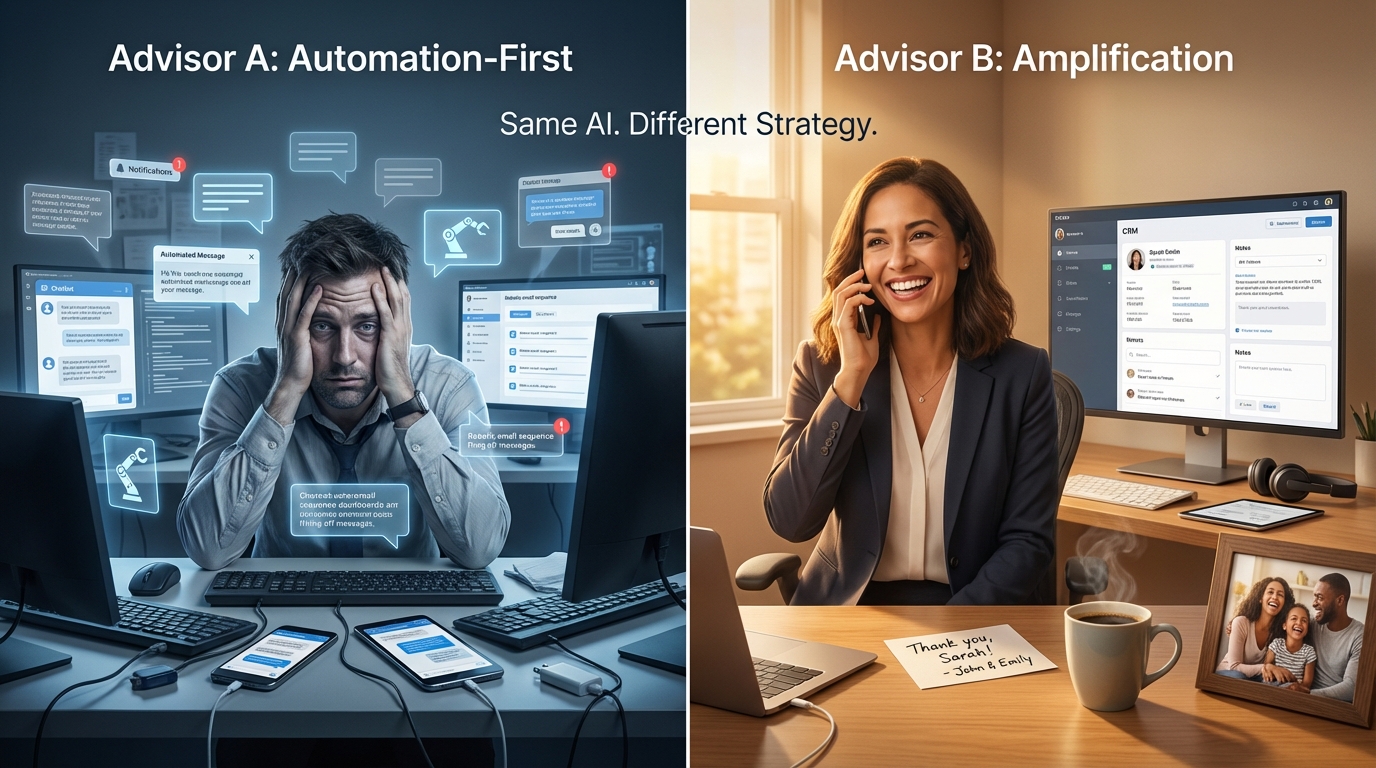
Two advisors. Same market. Same brokerage. Different AI strategy.
Advisor A: Automation-FirstAdvisor B: AmplificationAI StrategyAutomates lead follow-up with AI-generated messages. Uses AI for client communication: email sequences, text responses, appointment reminders. Relies on AI scheduling and property recommendations. Minimal personal outreach.Uses AI for CRM reminders, market research, scheduling logistics. AI handles data gathering and lead qualification. ALL client communication is personal: calls, in-person meetings, handwritten notes. Maintains Contact Ladder with 200 active relationships.Transactions/year8 (median advisor performance)32Repeat/referral rate5%68%GCI$200,000$750,000AI tool spend$800/month$200/monthBusiness modelConstantly prospecting for new leadsReferrals fuel business growthResultHigh stress, low loyaltyLow stress, high loyalty
Advisor A is efficient. But she used AI to avoid work instead of amplify it, and now she’s on a treadmill, always hunting for the next deal because nobody’s coming back.
Advisor B is effective. AI handles the tedious work (reminders, research, logistics), freeing up time for the human work that actually builds business.
The difference?
Advisor A automated relationships. Advisor B amplified relationships.
Advisor B didn’t start perfect. She started messy. Half her prompts were garbage. But six months of iterating built judgment that no tutorial or course can replicate. She learned what AI is good at (pulling comps in 30 seconds) and what it’s terrible at (following up with a nervous first-time buyer). That judgment compounds.
NAR data backs this up: Median advisor closes 8 deals per year. Top advisors (the ones maintaining deep relationships with 150-300 people) typically close 25-40+ deals annually. Not working harder. Working smarter.
This isn’t theory. This reflects the pattern across hundreds of advisors: the ones who build referral engines close 3-5x more deals than the ones chasing leads. The gap isn’t about talent or market conditions. It’s about relationship strategy.
Referrals are 7-8x more cost-effective than paid leads. Advisor A spends $800/month on tools and still buys leads. Advisor B spends $200/month and gets referrals.
Which advisor are you?
Your Game Plan (This Week)
Your action plan.
Step 1: Audit Your Current Automation
What are you automating right now? Run it through the five-question framework:
Does it require trust?
Does it require judgment?
Does it contain your personality or voice?
Would you do it differently based on the person?
Does it strengthen or weaken the relationship?
If automation weakens the relationship, kill it.
Today.
Step 2: Build Your Advocate List
Identify your raving fans: people who’ve referred you two or more times. Commit to personal contact with these people. No automated emails. No AI-generated check-ins. Real calls, real conversations, real relationships.
Goal: 20-50 Advocates. Start identifying them today. Write down names this week. Call the first five before Friday.
Step 3: Choose Your AI Stack (Cautiously)
Focus on tools that handle logistics, research, and reminders, not client communication.
Look for:
CRM with AI-powered reminders (not AI-powered outreach)
Market research tools
Scheduling coordination
Content creation assistance (with human editing)
Avoid:
Automated client communication tools
AI-generated follow-up sequences that replace personal outreach
Any tool that promises to “handle your relationships for you”
Remember: Only 130 vendors offer genuine agentic AI. The rest is agent washing.
Step 4: Practice the Human Skills AI Can’t Replace
Negotiation. Emotional intelligence. Complex problem-solving. Face-to-face relationship building.
These aren’t soft skills. They’re the highest-ROI skills in the agentic AI era.
The distinction is critical: technical skills are replicable. Human skills are not. AI can pull comps faster than you. It can’t sense when a seller is emotionally attached to a price and needs validation before they’ll negotiate. AI can draft a counteroffer. It can’t read body language across the table and know when to push vs when to give space. These judgment calls, the ones you make in real time based on years of experience, separate top advisors from average ones. AI isn’t closing that gap.
Great at data analysis but terrible at reading a room? You’re competing against advisors who use AI AND show up in person. Great at relationships and use AI to handle data analysis? You’re the one they’re trying to catch.
Step 5: Stay Informed But Skeptical
40% of agentic AI projects are failing. Don’t jump on every new tool. Don’t chase hype.
Watch what top producers do.
They amplify. They don’t automate relationships.
Frequently Asked Questions About Agentic AI in Real Estate
What is agentic AI and how is it different from regular AI?
Agentic AI independently analyzes, makes decisions, and acts autonomously to complete tasks without constant human input. Unlike traditional AI that follows scripts, agentic AI uses goal-oriented reasoning to adapt to changing conditions and figure out the best path forward. Think digital executive, not calculator.
Will agentic AI replace real estate advisors?
No. But advisors who use AI to avoid human work are being outcompeted by advisors who use it to amplify human work. Agentic AI handles logistics, research, and admin brilliantly. Relationship building, complex negotiation, emotional intelligence, and local market expertise stay human. The advisors who thrive use AI for the tedious stuff and invest the saved time into the relationships that generate 66% of their business. And the advisors building judgment around AI right now (learning what it’s good at, catching where it fails) are developing a skill their competitors can’t shortcut by adopting the same tools later.
What should real estate advisors automate vs keep human?
Automate: CRM reminders, market research, scheduling logistics, lead qualification, property research, and content drafts. Keep human: Follow-up calls with advocates and fans, personalized messages to your sphere, negotiation conversations, emotional client situations, and any communication where relationship depth matters. Use AI to remind you WHO to call, then YOU make the call.
Why do 40% of agentic AI projects fail?
Gartner reports 40% of agentic AI projects are being canceled due to escalating costs, unclear business value, and inadequate risk controls. Most failures happen when companies automate without strategy, chasing efficiency gains instead of amplifying human strengths. Real estate advisors face the same risk when they automate relationships instead of logistics.
How can I tell if an AI tool is actually “agentic” or just marketing hype?
If a vendor can’t explain how their system adapts to changing conditions, learns from feedback, and acts autonomously toward goals, it’s not agentic AI. It’s just automation with better branding. Gartner calls this “agent washing.” Only about 130 vendors worldwide offer genuine agentic AI products. Ask: Does it follow scripts or does it reason toward goals?
The Bottom Line
Agentic AI is here. Real, powerful, already transforming real estate.
40% of agentic AI projects are failing because companies chase hype without strategy. Real estate advisors face the same fork.
Path A: Use AI to avoid work. Automate follow-up, automate relationships, automate the uncomfortable stuff. Join the 40% that fail because they pointed incredible technology at the wrong things.
Path B: Use AI to do more work. Automate logistics, research, reminders, then invest the saved time into more calls, more relationships, more showing up. Use the most powerful tool you’ve ever had to become the most human advisor in your market.
Path C: Wait for the tools to get better. Sounds reasonable. Worst outcome of the three. Perfect tools plus zero judgment equals the advisor who adopts AI in 2028 and has no idea what to do with it. You can learn every feature of every tool overnight. You can’t download six months of judgment. The advisors who start now, even badly, are building pattern recognition that compounds like interest: invisible early, unstoppable later.
The data is clear: 66% of sellers find their advisor through referrals (NAR).
You can’t get referrals from a bot.
The advisors still standing won’t be the ones with the best tools. They’ll be the ones who built the best judgment. And you can’t build judgment from the sideline.
Same AI. Different strategy. One builds an empire. The other burns out.
Not less AI. Better AI.
Pick a side.