
Everyone treated their database the same. Then the referrals dried up.
You have 500 contacts in your CRM. You set up one drip campaign. Everyone gets the same email on the same schedule. Maria (who referred you three deals last year) gets the same automated market update as Jeff, a Zillow lead who doesn’t remember requesting info.
Maria noticed.
She didn’t say anything. She just stopped thinking of you first. And when her coworker asked for an agent recommendation last month, she said someone else’s name.
After 21 years in real estate operations (managing 1,200 agents across 8 offices in 5 states), I can tell you this is the single biggest mistake in sphere of influence real estate strategy. Almost every agent makes it. One audience. One automation. One cadence. And the people who actually drive your business (the ones who refer without being asked) drown in the same noise as everyone else.
The fix isn’t more automation. It isn’t less automation either.
It’s a system. Different levels of AI and personal attention for different tiers of your database.
I call it the Contact Ladder. If you’ve read my piece on AI as an amplifier, you’ve seen me reference it. Every agent problem I see traces back to it. But I’ve never gone deep on HOW to build the thing.
This is that article.
Your Brain Literally Can’t Do This
Before we build anything, you need to understand why winging it doesn’t work.
Evolutionary psychologist Robin Dunbar studied primate brains and social groups. His conclusion: humans can maintain approximately 150 meaningful relationships. Not 500. Not 1,000. About 150.
And those 150 aren’t equal. Dunbar found they exist in layers:
5: Your innermost circle. Intimate relationships.
15: Close friends you’d turn to in a crisis.
50: Good friends you see regularly.
150: Meaningful contacts you can maintain socially.
500+: Acquaintances. You recognize the face, maybe the name.
Each layer is roughly 3x the size of the one inside it. This pattern shows up everywhere: Christmas card lists, military units, church congregations, Bronze Age villages. It’s been validated across 23 studies spanning cultures, historical periods, and 61 million individuals.
This is biology. Not a time management problem. Not a motivation issue. Not something a better planner or a Tony Robbins seminar will fix. Your neocortex has a hard ceiling.
So when your coach tells you to “personally touch everyone in your database” and you have 500 people in your CRM, you’re being set up to fail. Not because you’re lazy. Because you’re human. And every guru selling “just stay in touch with everyone!” is selling BS that contradicts decades of cognitive science.
The agents who win don’t try harder. They get strategic about WHO gets their deepest attention. I’ve watched the top producers across our brokerage for years. The ones closing 30+ deals aren’t the ones with the biggest databases. They’re the ones who know exactly which 25 people matter most, and treat them accordingly.
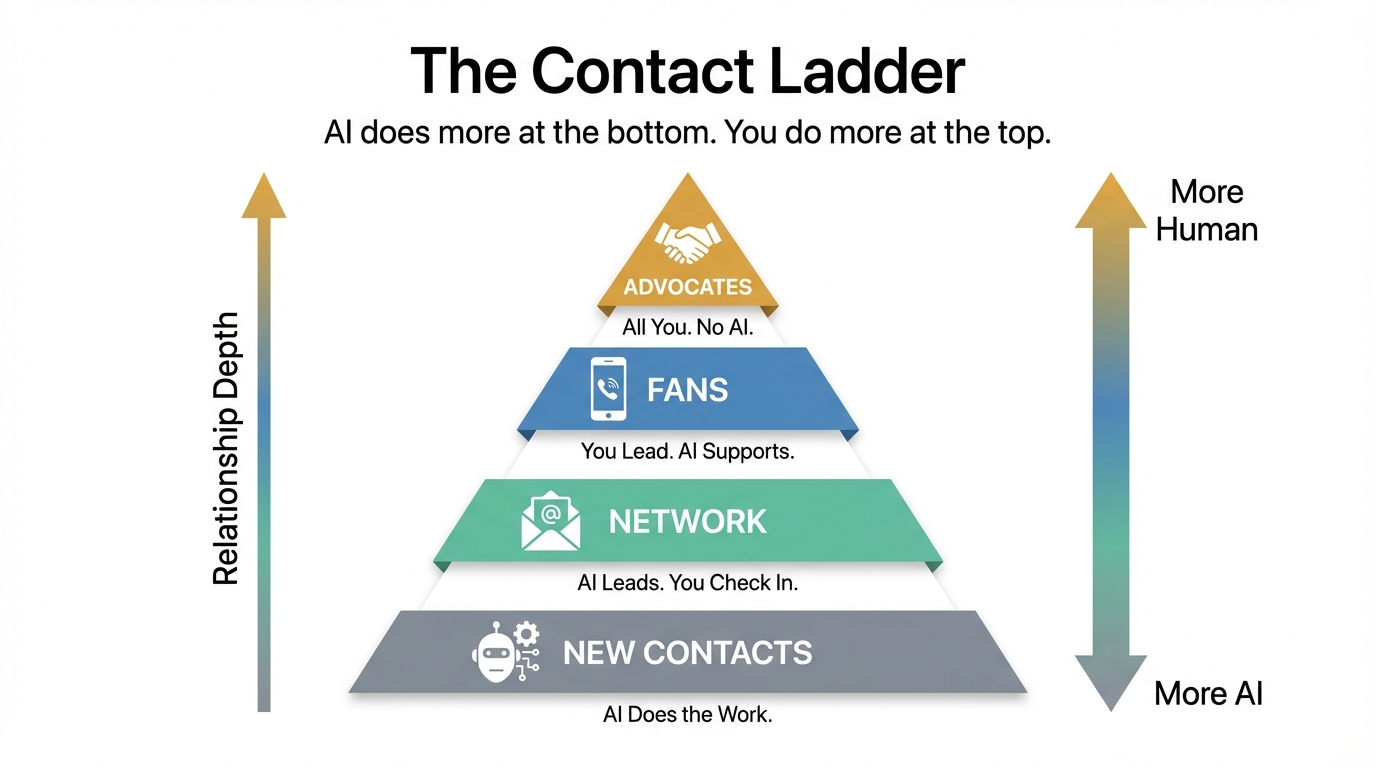
The Contact Ladder: Your Sphere of Influence in Real Estate, Tiered
Your sphere of influence in real estate isn’t one big group. Treating it like one is why your referrals are inconsistent.
It’s a ladder with four rungs. Each rung requires a completely different strategy: different AI involvement, different personal investment, different outcomes. Treating them the same is like giving your spouse the same birthday present you give your mailman.
Tier 1: Advocates (20-30 People)
Your inner circle. The people who refer you without being asked. When someone at a dinner party mentions buying a house, your Advocate says your name before the question is even finished.
You probably know who they are. Maria, who sent you three deals last year. Tom, who posts your listings on his Facebook without you asking. Sarah, who physically hands your business card to her coworkers.
Twenty to thirty people. That’s it.
What Advocates need from you: Personal, human-to-human contact. Calls. Coffee. Handwritten notes. Face time. These people ARE your business. They need to feel like your most important clients, because they are.
Touch frequency: Monthly personal contact. Not automated. You, on the phone or across the table.
Tier 2: Fans (60-100 People)
Past clients who loved working with you. Sphere connections who’d absolutely refer you, if they remembered you existed at the right moment. That’s the key phrase: at the right moment.
Fans are one consistent touch away from becoming Advocates. And one period of neglect away from sliding into the abyss.
What Fans need from you: Regular visibility plus periodic personal contact. They need to see your name and hear from you often enough to stay warm.
Touch frequency: Personal contact every other month. AI-assisted touches in between.
Tier 3: Network (100-200 People)
People who know you but haven’t worked with you. Neighbors, friends of friends, former coworkers, event connections. They know you’re in real estate. They’d use you if you stayed on their radar.
What your Network needs: Consistent visibility. When real estate comes up, you need to be the name they think of.
Touch frequency: Quarterly personal calls to rotating groups. AI handles visibility in between.
Tier 4: New Contacts (Everyone Else)
Everyone starts here. They don’t know you. They don’t trust you. Half of them don’t even remember giving you their info.
What New Contacts need: Speed and qualification. Fast responses, consistent follow-up, and a path to becoming a real relationship, or being filtered out.
Touch frequency: AI-heavy. Automated qualification, drip sequences, speed-to-lead responses. You step in when they show real buying or selling signals.
Where AI Fits at Every Tier
Here’s where most agents get it exactly backwards.
They automate their best relationships (Advocates getting generic birthday emails from their CRM) and then manually chase new leads (frantically calling Zillow inquiries at 10 PM).
Flip it. AI does MORE at the bottom of the Contact Ladder and LESS at the top.
Advocates: AI as Intelligence Gatherer
AI’s job with Advocates is simple: make sure you never drop the ball.
AI flags when an Advocate hasn’t been contacted in 30+ days
AI tracks life events: birthdays, work anniversaries, home anniversaries, kids’ milestones
AI surfaces context before your call: “Maria’s daughter started college in August. She referred you 3 deals last year. Last real conversation: 22 days ago.”
AI logs your interactions so nothing slips through the cracks
What AI does NOT do with Advocates: Send emails on your behalf. Make calls. Write texts. Generate birthday messages. Nothing automated goes to these people. Nothing.
You pick up the phone. You write the note. AI just makes sure you know WHEN and WHAT to say.
Fans: AI as Cadence Manager
AI plays a bigger role with Fans, but you’re still the main event.
AI sends market updates and content between your personal touches
AI tracks engagement: who opened 3+ emails, who clicked a listing, who visited your site
AI alerts you when a Fan shows buying/selling signals
AI drafts personalized follow-ups for your review (you edit and send)
The rule: When AI flags engagement, you call within 24 hours. AI keeps you visible. You keep you meaningful.
Network: AI as Visibility Engine
Your Network is too large for consistent personal contact but too valuable to ignore. This is where AI earns its money.
AI handles 3+ automated touches per month: emails, market updates, content
AI nurtures at baseline without you spending hours on it
AI identifies people who engage consistently (potential Fan upgrades)
Your role: Quarterly personal calls to a rotating group. The occasional text that surprises them. The goal is to move Network contacts UP to Fan status.
New Contacts: AI Does the Heavy Lifting
This is where AI shines brightest, and where most agents mistakenly think it should shine everywhere.
Speed-to-lead responses at 2 AM? AI handles it.
Automated qualification sequences? AI handles it.
8-touch drip campaigns over 8 weeks? AI handles it.
Initial lead nurture for people who aren’t ready? AI handles it.
The handoff: Once AI qualifies a lead and they show real interest, YOU take over. AI got them to raise their hand. Now shake it. That human connection turns a New Contact into a Network relationship, and eventually, maybe, an Advocate who drives your business for a decade.
The Pattern
Read it from top to bottom:
TierAI LevelYour LevelKey MetricAdvocates (20-30)Minimal (intel & reminders)Maximum (all communication)Referrals givenFans (60-100)Moderate (content & tracking)High (personal touches)Engagement + referralsNetwork (100-200)Heavy (visibility at scale)Moderate (quarterly calls)Movement to Fan tierNew ContactsMaximum (automation)Minimal (close when qualified)Conversion to Network
AI does more at the bottom. You do more at the top.
Not less AI. Strategic AI.
What This Looks Like: Flat Database vs. Contact Ladder
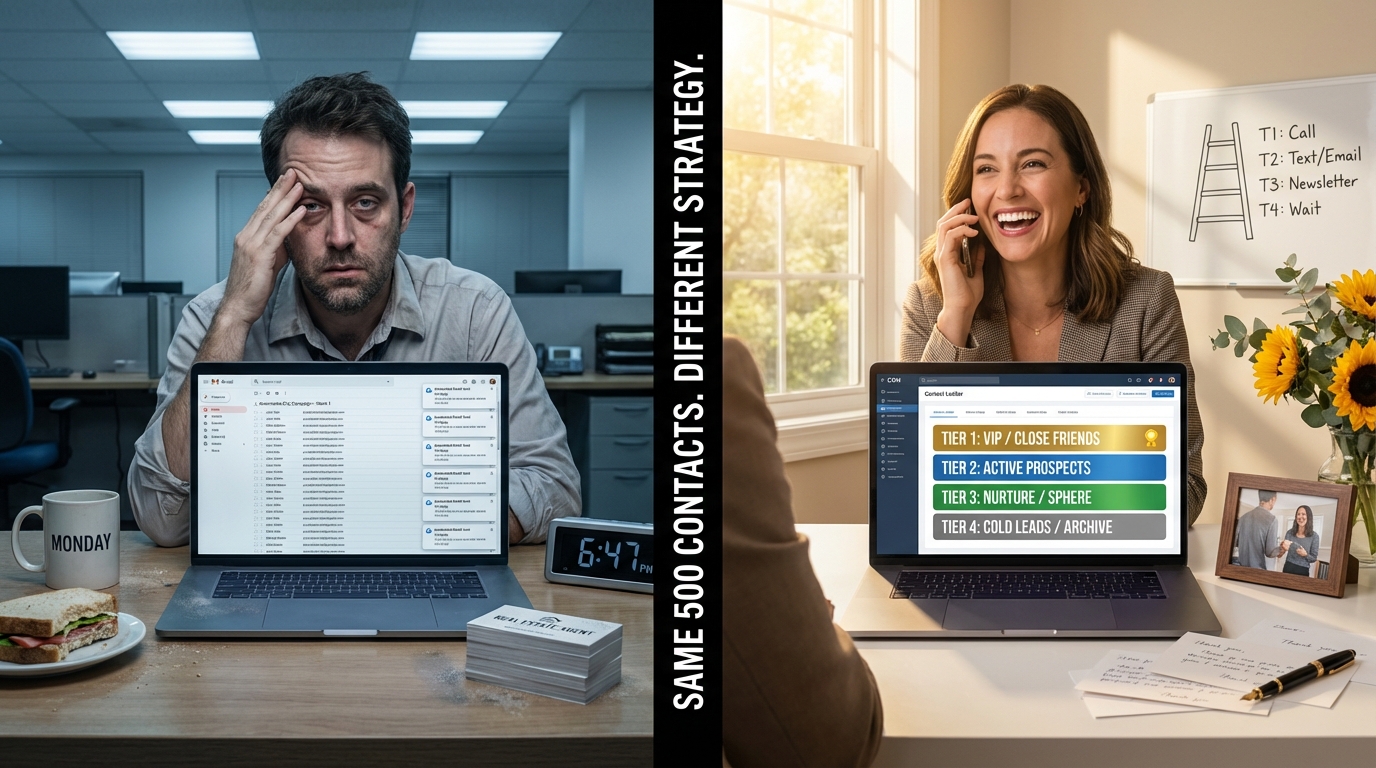
Flat Database AgentContact Ladder AgentAI strategySame automation for everyoneDifferent AI per tierAdvocate treatmentGeneric drip like everyone elsePersonal calls, AI intel onlyNew lead responseManual (slow, inconsistent)AI-automated (instant, 24/7)Time spentEqual across database60% on top 30 peopleReferral rateDeclining yearlyCompounding yearlyAnnual deals8-1225-35Marketing spend$3,000-5,000/month$500-800/monthTrajectoryChasing leads foreverPhone rings without advertising
Same tools. One agent tiers them. One agent doesn’t. Look at the outcomes.
How to Segment Your Database Right Now
Stop reading and do this. I’m serious. Today. Not “this weekend.” Not “when things slow down.” Block 90 minutes and do it today.
Step 1: Identify Your Advocates
Open your CRM. Answer one question for each contact: “Has this person referred me business or actively promoted me in the last 12 months?”
If yes, they’re an Advocate. Tag them.
You should have 15-30 names. If you have fewer than 10, that’s your first problem, and this article will help you fix it. If you have more than 40, you’re being generous with the definition. An Advocate actively sends you business without being asked.
Step 2: Identify Your Fans
Next question: “Have I done a transaction with this person, and would they refer me if someone asked?”
Past clients you had a good relationship with. Sphere connections who’d send people your way. People who engage with your content and genuinely like you.
Tag them. Should be 60-100 people.
Step 3: Identify Your Network
Everyone you know personally but haven’t done business with. Friends, neighbors, event contacts, old colleagues.
Tag them as Network. This is your largest group: 100-200 people.
Step 4: Everyone Else is New Contacts
Zillow leads. Open house sign-ins. Website inquiries. Cold contacts. Anyone who hasn’t had a real conversation with you goes here.
Step 5: Set Up Separate Workflows
This is the critical step most agents skip. Create different automations for each tier:
Advocates: Remove from ALL automated sequences. Set up manual reminders only. Create a recurring task: “Call [Advocate name]” every 30 days.
Fans: Light automation (market updates, content). Set personal touch reminders every 60 days.
Network: Full content automation. Set quarterly call reminders for rotating groups.
New Contacts: Full automation (drip campaigns, qualification sequences, speed-to-lead).
If your CRM can’t segment this way, it’s the wrong CRM. I’ve delivered 15+ hours of CRM training across our brokerage. The number one thing that separates agents who get results: tiered workflows. Not more features. Not a fancier platform. This is the operating system of your business.
Moving People UP the Ladder
The Contact Ladder isn’t static. People move up and down based on how you treat them, and managing that movement is the real skill of sphere of influence real estate. The goal is always UP.
New Contact to Network
Trigger: Your first real conversation.
Not a form submission. Not an automated text. An actual conversation where they learn something about you and you learn something about them. Their kid plays soccer. They’re renovating their kitchen. They just moved from Denver. Something real.
After that conversation, move them to Network. Start the visibility engine. They know you’re a person now, not a chatbot with a real estate license.
Network to Fan
Trigger: First transaction or a meaningful personal connection.
When a Network contact does a deal with you, or develops a genuine personal relationship (you’re at the same kids’ soccer games, you connect over a shared interest), they become a Fan.
Increase personal contact frequency. Reduce automation. They’ve earned more of you.
Fan to Advocate
Trigger: They refer you their first deal. Or they proactively promote you without being asked.
You can’t manufacture this. You can only create the conditions.
Exceptional service during their transaction. Consistent follow-up afterward. Making them feel like they matter, not just their commission check. When someone becomes an Advocate, it’s because they trust you as a person.
When it happens, shift them to Advocate tier immediately. Maximum personal attention. Minimum automation.
The Gravity Problem
Most agents can only move people DOWN. Not because they try to, but because neglect is the default.
You close a deal. The client was thrilled. They’re a Fan, maybe even a future Advocate. Then you get busy. Three months pass. Six months. A year. They got a generic drip email every month, but they haven’t heard your voice since closing day.
They’re not a Fan anymore. They’re Network. Maybe less. And when their coworker asks them for an agent recommendation, your name doesn’t come up. Not because they had a bad experience, but because someone else is more present.
AI prevents this. Not by automating the relationship, by reminding you to maintain it. I’ve seen this play out hundreds of times across our offices. Agent closes a deal, gets a five-star review, then lets the relationship go cold chasing the next transaction. The technology to prevent it exists. Most agents point it at the wrong tier.
The Math That Makes This Work
Let’s get specific.
20 Advocates who each refer you 1-2 deals per year = 20-40 referrals.
At a 50% conversion rate (referrals close at much higher rates than cold leads) = 10-20 closed deals from Advocates alone.
Add your Fans: 80 Fans, 10% generate a referral or repeat transaction = 8 more deals.
Add your Network conversions: 150 Network contacts, 3-5% do business = 5-7 more deals.
Total: 23-35 deals per year. From relationships, not lead spend.
Compare that to $5,000/month on Zillow leads for 8 deals. The NAR 2025 Profile confirms it: 66% of sellers find their agent through a referral or past relationship. 81% contact only one agent. You’re either that agent or you’re not in the conversation.
The full AI amplifier vs. replacement breakdown makes the economics brutally clear.
The Contact Ladder isn’t a nice-to-have. It’s the business model.
Red Flags You’re Treating Everyone the Same
Your Advocates get the same automated emails as your Zillow leads
You can’t name 20 Advocates off the top of your head
You haven’t made a personal call to a top referral source in 30+ days
Your CRM has one “drip” that goes to everyone
Referrals dropped this year but your “touches” are up
Past clients seem surprised when you call them personally
You saved 20 hours a week with automation and spent zero of them on more personal outreach
Three or more? You’re not managing a sphere of influence in real estate. You’re managing a mailing list. And mailing lists don’t generate referrals.
Frequently Asked Questions
How many contacts do I need in my sphere of influence for real estate success?
Fewer than you think. An agent with 25 Advocates and 80 Fans will bury an agent with 2,000 untiered names in a CRM every time. The agent with 2,000 names feels productive. The agent with 25 Advocates is closing 30 deals. Stop counting contacts. Start counting Advocates.
Can I really manage 200+ relationships without burning out?
Not without AI. That’s the entire point. You CAN’T maintain 200 deep relationships. Dunbar proved that. So don’t try. AI manages visibility for your Network and qualification for New Contacts. You invest your finite capacity where it compounds: 25 Advocates and 80 Fans. That’s 105 people you’re personally managing. The rest are on AI. This isn’t burnout. It’s strategic deployment of a limited resource (you).
What if I’ve been treating everyone the same for years?
Then your Advocates have been slowly demoting to Fans, and your Fans have been sliding to Network, and you don’t even know it. Fix it now. Segment into four tiers today. Call your top 10 Advocates this week. Be honest: “I’ve been leaning too hard on automation for the people who matter most.” They already know. Acknowledging it is the first step back.
How long does it take to build a strong Contact Ladder?
Six to twelve months for compounding results. You can’t manufacture Advocates overnight. But you’ll notice movement within 30 days of segmenting and personally calling your top tier. Referral conversations start fast when people hear your actual voice instead of your drip campaign. The real question isn’t “how long?” It’s “how much have you already lost by waiting?”
What CRM features do I need for the Contact Ladder?
Four things: tagging, separate automated workflows per tag, activity reminders, and engagement tracking. Most modern CRMs handle this. If yours can’t run different automations for different tiers, switch. Your CRM’s job is to help you treat Advocates differently than Zillow leads. If it can’t, it’s expensive software doing nothing useful.
Two Agents. Same Database. Pick One.
Agent A has 500 contacts. One drip. One automation. Everyone gets the same experience. Her Advocates (the 25 people who actually drive her business) receive the same generic market update as a Zillow lead from six months ago. She’s “efficient.” She’s also doing 8 deals a year and spending $60,000 on lead gen trying to make up for the referrals that stopped coming.
Agent B has 500 contacts. Four tiers. Four strategies. AI handles the bottom two tiers: speed-to-lead, qualification, visibility at scale. She invests herself at the top: monthly calls to her 25 Advocates, bi-monthly touches to her 80 Fans. She spends less on marketing than Agent A spends on her CRM subscription. She closed 32 deals last year, almost all from referrals.
Agent B uses MORE AI than Agent A. She just points it at the right things.
Same tools. Different strategy. $250,000 difference.
The agents doing 30+ deals aren’t working harder. They aren’t spending more on marketing. They aren’t using less AI.
They’re using AI to do MORE human work, not less.
Your sphere of influence in real estate isn’t a mailing list. It’s a ladder. Build it. Tier your database. Let AI handle the bottom. Then pick up the phone and call Maria.
She’s been waiting to hear from you.
Pick a side.