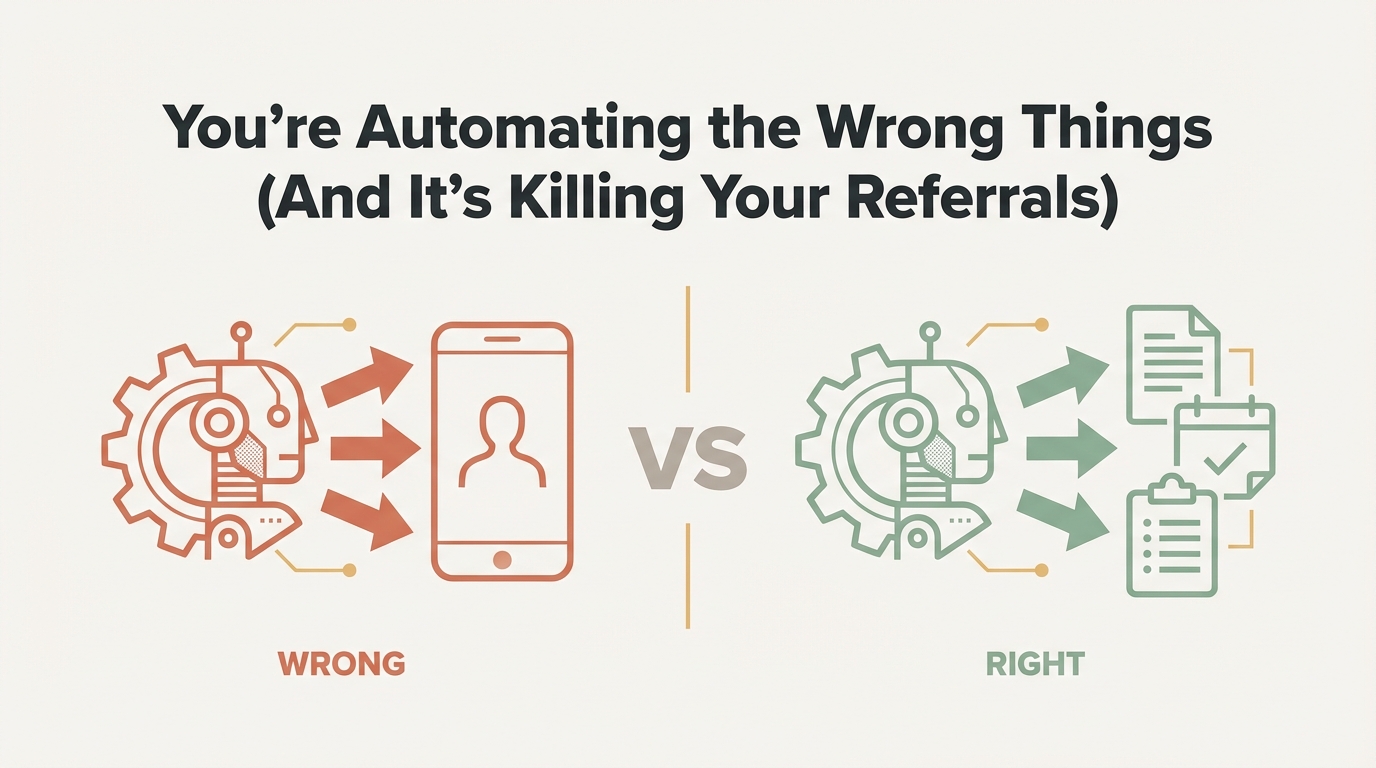
AI can handle your entire follow-up system. Every lead response, every check-in, every birthday text, every market update. Fully automated. Zero effort.
And that's exactly the problem.
Not AI itself. AI is incredible for follow-up. It can respond to leads at 3 AM, remind you who to call and when, compile market data into reports, manage your entire database without missing a single date. The technology is the best thing that's ever happened to real estate agents.
The problem is agents using AI to avoid follow-up instead of using it to do more of it.
There's a pitch you're hearing everywhere in 2026: automate your real estate follow up, save massive time, scale your business, never miss a lead. The gurus selling this pitch aren't wrong about the tools. They're wrong about the strategy. "Let AI handle your relationships while you sleep" sounds like freedom. It's actually a plan to destroy the part of your business that generates 66% of your revenue.
The best agents? They use AI more than anyone for follow-up. They just point it at different things.
AI handles the admin, the data, the reminders, the logistics. They handle the calls. More calls than they ever made before, because AI freed up the time.
Same tools. Different strategy. $250,000 difference.
The Follow-Up Pitch You're Hearing (And Why It's Half-True)
The pitch is everywhere. "Save 20 hours per week!" "Research shows 37% of tasks can be automated!" "AI will handle your follow-up!"
Here's the thing: half of that is true.
Speed to lead matters. If you're not responding within an hour (78% expect it), you're losing deals. Consistency matters: your database won't nurture itself. CRM beats spreadsheets. AI handles appointment reminders, initial responses, and transaction coordination better than manual tracking.
The half they skip? What happens to the 66% of your business that comes from referrals when your Advocates get the same automated drip campaign as your Zillow leads.
According to NAR 2025 data, 66% of home sellers found their agent through a referral or used an agent they'd worked with before. Among agents with 16+ years of experience, 40% of their business comes from repeat clients.
You can't automate your way into someone's top-of-mind. But you CAN use AI to make sure you never let a relationship slip through the cracks.
The gurus aren't lying about the tools. They're giving you a strategy that points those tools at the wrong things.
The Real Costs of Pointing AI at the Wrong Things
The CRM pricing page says $50 per month. Maybe $100 if you want the good features. $200 if you're scaling.
That's not the real cost.
The Obvious Cost: Subscription Fees
Let's start with what you can see. Basic CRM automation runs $15-$69 per user per month. That's Follow Up Boss, Lofty, HubSpot's real estate tier. Reasonable.
But agents don't stop there. They add AI chatbots ($20-$50/month), automated video messaging ($33-$50/month), SMS automation ($50/month), and then the real money pit: "done-for-you" lead gen platforms ($300-$1,000/month for CINC, BoomTown, Ylopo). Before they know it, they're spending $400-$1,200 per month on features they barely use.
If you're closing 8-10 deals per year (industry median), that's $4,800-$14,400 annually on tools. More than most agents spend on lead generation.
The Hidden Cost: Setup and Training
Data migration isn't free. You're moving contacts from spreadsheets, old CRMs, email lists, business cards from that conference two years ago. The migration process involves complex mapping, data cleansing, and transformation.
Then there's training. Not just the initial "here's how to use it" session. Ongoing training as the platform updates. Training for your assistant or team members. Re-training when you realize you set it up wrong the first time.
Training is both a time investment and a hidden monetary cost, varying depending on complexity and team size. Most agents spend 20-40 hours in the first three months just learning the system.
At $200 per hour (what your time is worth if you're closing deals), that's $4,000-$8,000 in opportunity cost.
The Invisible Cost: What You're Doing With the Saved Time
Here's the cost nobody talks about: the 20 hours per week AI "saved" you.
What are you doing with those hours?
If you're using them to make more personal calls to your Advocates and Fans, high ROI. That's AI as amplifier. If you're building deeper relationships with your sphere, excellent. That's the play.
But if you're using those 20 hours for more Zillow leads, more cold prospecting, more tweaking automation scripts to replace the referrals that dried up, you didn't save time. You shifted where you spend it. And you shifted it from the highest-ROI activity (relationship building) to the lowest.
And if you're honest? Some of those hours went to Netflix. No judgment. Just math.
The Underutilization Tax
One of the most insidious hidden costs is underutilization. You're paying for features you don't use, or worse, features you should be using but don't because nobody trained you properly.
CRM providers love add-ons. Dialer add-on? $33-$39 per user per month. Premium tier with AI lead scoring? Another $100+. Custom integrations? Extra. Support that actually responds? Premium tier.
Most agents end up paying for features they'll never touch because the sales pitch sounded good.
The 90/12 Problem: Why AI Can't Replace What Matters
Here's the stat that should make you uncomfortable: 90% of real estate consumers say they'd recommend their agent. Only 12% actually do.
Why the gap? Because agents fail to stay in touch in a meaningful way after the sale.
"But I AM staying in touch!" you say. "I have them in my drip campaign. They get my monthly market update. I sent them a birthday email last month."
Right. An automated birthday email. And they forgot you exist.
AI solves the consistency problem. It doesn't solve the memory problem.
Your past clients don't remember you because of the 37th market update email they didn't open. They remember you because you called them when their kid graduated. Because you sent a handwritten note after closing. Because you showed up at their housewarming party.
AI creates touches. Human effort creates memories. The agents who win use AI to make sure they never miss the moment, then they show up personally.
Here's the psychology: relationships form through reciprocal investment. When someone invests time in you (closes on a house, trusts you with their biggest purchase), your brain expects reciprocal investment back. Automated emails don't register as investment. They register as the minimum effort required to stay on a list.
Your past clients' brains are keeping score. Every automated email that could have been a call registers as "they're too busy for me." After enough of those signals, they stop thinking of you as their agent. They think of you as someone who used to help them.
The fix isn't less AI. It's pointing AI at admin and logistics, then using the freed-up time to make MORE personal calls than you ever did before.
NAR data shows that experienced agents (16+ years) get 40% of their business from repeat clients. Not because they have less technology. Because they built relationships that lasted, and the best of them use AI to build even more.
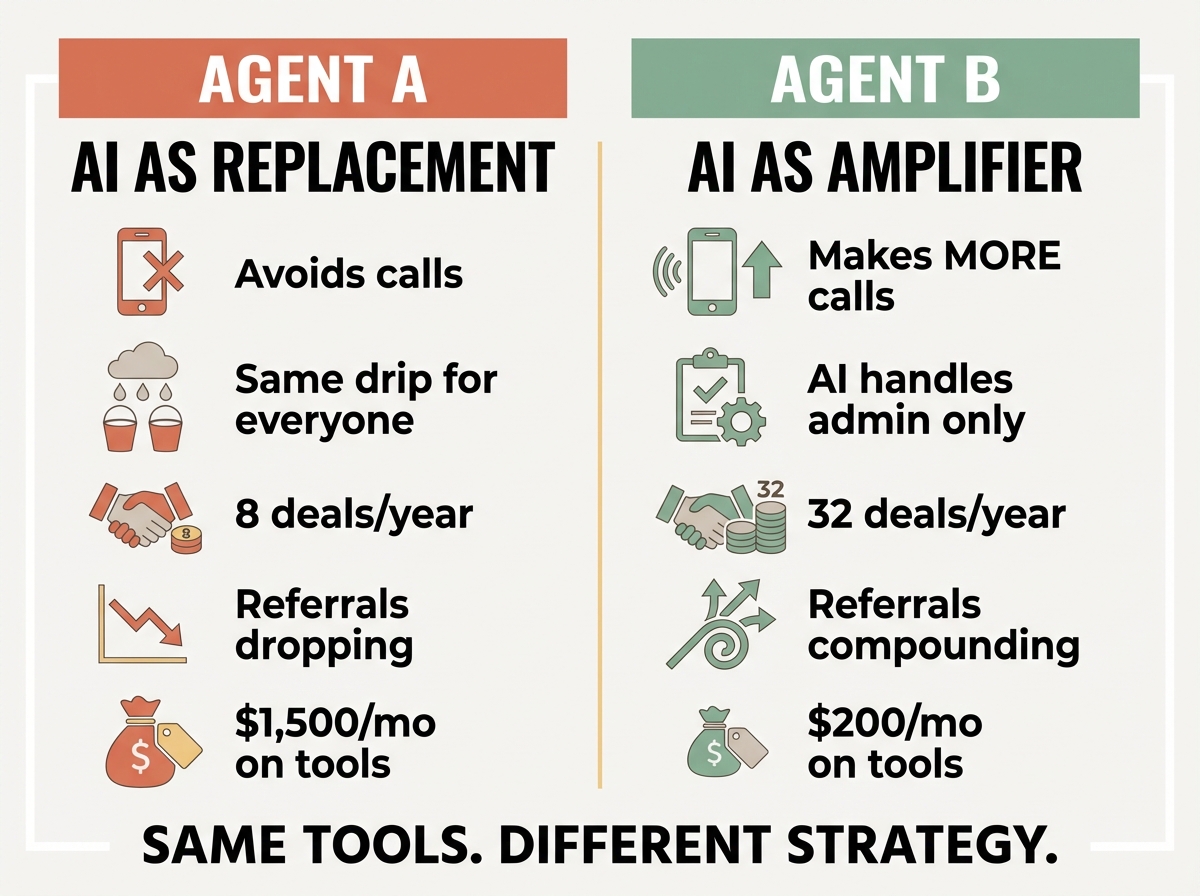
Agent A vs Agent B: Same AI Tools, Different Strategy
Let me show you two agents. Both have Follow Up Boss. Both use AI. Both have a database of 250 people.
Agent A: AI as Replacement
Agent A uses AI to avoid calls. Every contact gets the same treatment:
AI sends automated birthday emails
AI runs monthly market update drip campaigns
AI sends quarterly "Just checking in!" text messages
AI handles anniversary emails on closing dates
Agent A saved 20 hours per week. No manual follow-up. No calls unless someone replied. She uses the saved time to chase more Zillow leads and tweak her automation scripts.
Result: 8 deals closed last year. 25% came from referrals (down from 50% two years ago). Agent A doesn't understand why nobody calls anymore.
Agent B: AI as Amplifier
Agent B uses the same CRM. More AI, not less. Different strategy.
Her database is segmented by Contact Ladder tiers, and AI plays a different role at each level:
A - Advocates (her 30 raving fans, 4+ referrals each): AI flags who hasn't been contacted in 45 days, tracks life events, gives her conversation context. She makes personal calls every quarter and does in-person coffee twice a year.
B - Fans (80 people who'd refer if asked, 1-3 referrals each): AI sends market updates between personal touches and alerts her when someone opens 3+ emails in a row. She calls within 24 hours of an engagement signal.
C - Network (past clients, zero referrals): AI handles 3 auto-flow touches per month. She makes personal calls quarterly.
Sphere of Influence (40 people she's met but hasn't transacted with): AI reminds her to keep in touch every 30-60 days and flags when someone's showing buying signals.
D - Eight by Eight (people showing buying signals): AI schedules 8 touches over 8 weeks. She personalizes every touch and shows up for the in-person meeting at the end.
Agent B's AI does MORE than Agent A's. Her CRM reminds her WHO to call and WHEN, gives her the context to make every conversation count, and handles all the admin that used to eat her day.
Result: 32 deals closed last year. 68% came from referrals and repeat business. Agent B's phone rings without paid advertising.
The difference: Agent A uses AI to avoid the uncomfortable calls. Agent B uses AI to make more of them.
This isn't a hypothetical. The split between replacement-strategy agents and amplifier-strategy agents shows up in every market. The agents building referral businesses share one trait: AI handles admin and logistics while they handle relationships.
Red Flags You're Pointing AI at the Wrong Things
Stop and check yourself. If any of these are true, your AI strategy needs redirecting:
Your referral rate dropped 20%+ in the past year
You can't name your top 10 Advocates off the top of your head
Your Advocates get the same emails as your Zillow leads
You feel "caught up" on database work but haven't made a personal call in 3 weeks
Clients seem surprised when you call them personally
You saved 20 hours a week and spent zero of them on more personal outreach
You're spending $800+/month on AI tools and lead gen but closing 8 deals/year
One or two of these? Warning sign. Three or more? You're using AI as a crutch, not an amplifier. The fix isn't less AI. It's redirecting it.
The 5-Test Framework: Where Should AI Handle This?
Before you automate any touchpoint, run it through these five tests. This isn't about whether to use AI. It's about what you point it at.
Test 1: Does This Task Build Trust or Maintain Logistics?
Trust-building = human. Logistics = AI.
Examples:
Appointment reminder: AI handles it (logistics).
"Just checking in" call to past client: You handle it (trust-building).
Market stats email: AI handles it (information delivery).
"I saw this article and thought of you": You handle it (relationship).
Test 2: Does This Require Context About the Relationship?
If you need to remember where you left off, what matters to them, or any personal detail, AI gathers the context and you deliver the message.
Examples:
New lead inquiry response: AI handles initial reply (no context needed yet).
Follow-up with someone who mentioned their daughter's wedding: You call, armed with the context AI tracked for you.
Test 3: Would a Stranger Doing This Task Be Weird?
If it would be weird from a stranger, it's weird from a bot.
Examples:
Sending listing alerts: Not weird. AI handles it.
"Happy anniversary on your home purchase!": Weird from a stranger. You call.
Asking how their mom's surgery went: Very weird from a stranger. DEFINITELY you.
Test 4: Is This Time-Sensitive?
Speed matters for new leads. AI wins the speed-to-lead race.
Examples:
"Got your inquiry, I'll call you at 2pm today": AI sends this instantly (speed matters).
Calling them at 2pm: You make the call (this is the actual relationship moment).
Test 5: What's Their Contact Ladder Tier?
A - Advocates: AI gathers intel and reminds you. You handle all communication.
B - Fans: AI manages cadence and flags engagement. You handle personal touches.
C - Network: AI handles most outreach. You make quarterly personal calls.
Sphere of Influence: AI tracks engagement and reminds you to keep in touch every 30-60 days. You watch for buying signals.
D - Eight by Eight: AI schedules 8 touches over 8 weeks. You personalize every one and show up for the in-person meeting.
Apply this framework to your current setup. You'll probably find AI is handling things that should be human, and you're doing manually what AI could handle in seconds.
What AI Should Handle vs What You Should Handle
Here's the breakdown:
AI Handles (Admin, Logistics, Data)
Initial lead responses and qualification at 3 AM
Appointment confirmations and reminders
Transaction coordination and task management
Market update compilation and distribution
Birthday/anniversary reminders (so YOU know to call them)
D-tier 8x8 campaigns (8 touches over 8 weeks for SOI contacts showing buying signals)
CRM data entry and contact organization
Social media post scheduling
Engagement tracking (who opened what, who clicked, who's going cold)
Draft emails and content for your review
You Handle (Relationships, Trust, Connection)
Personal calls to Advocates and Fans
Reconnecting with past clients who've gone quiet
Asking for referrals or testimonials
Following up on personal milestones you know about
Responding to "just browsing" inquiries (they need YOU, not a template)
Crisis situations or sensitive conversations
Thank you notes after referrals
Calls when AI flags that someone engaged with your content
The pattern: AI handles everything that doesn't require your voice, your memory, or your relationship, and you handle everything that does.
Not less AI. Better AI.
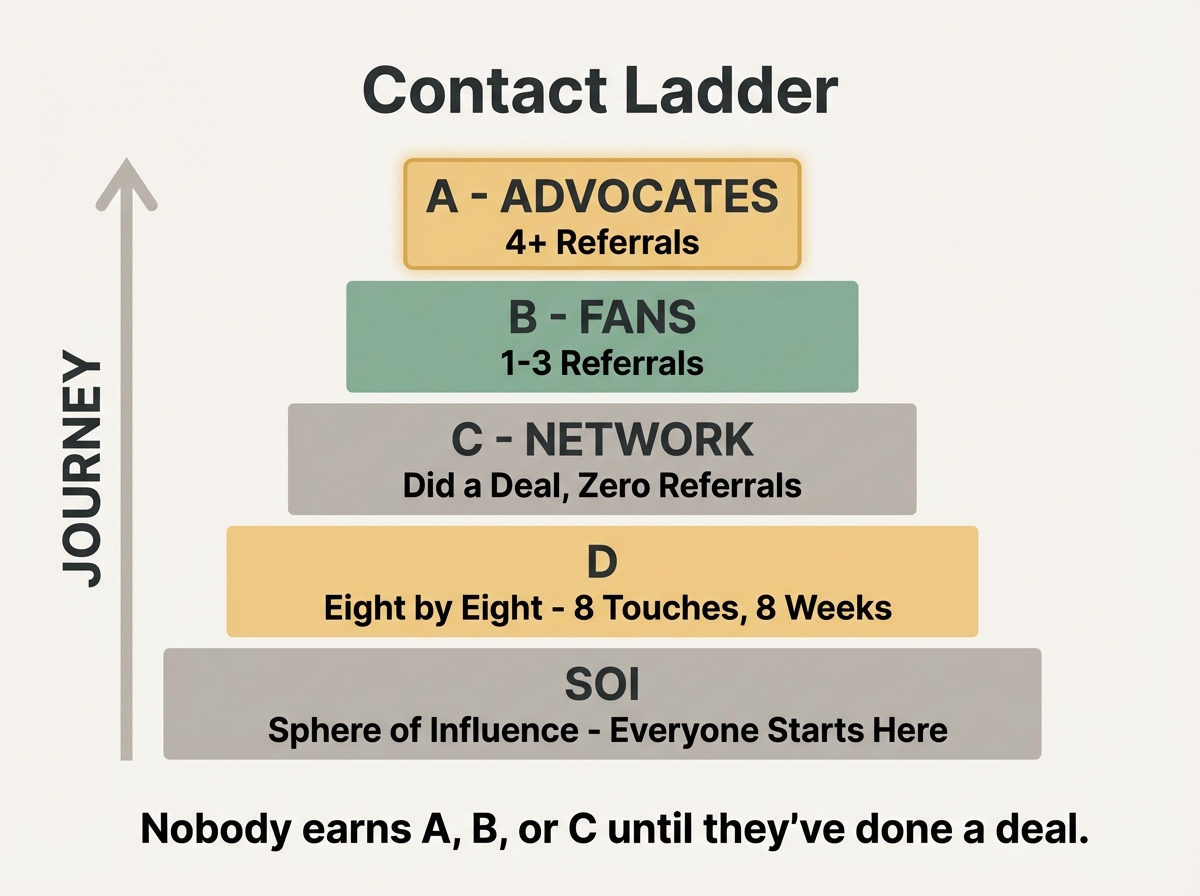
The Contact Ladder: AI's Role at Every Tier
Your AI strategy should change based on relationship tier. One-size-fits-all automation is the laziest possible use of the most powerful tool you've ever had.
Here's what matters about the Contact Ladder: nobody starts at the top. Everyone enters in your Sphere of Influence. Nobody earns A, B, or C until they've done a deal with you. After the deal closes, you watch their referral behavior for a year. Then you categorize based on what they actually did, not what you hope they'll do.
Only your A and B contacts count toward your target database number. These are the people you're in flow with. These are the ones that matter.
Sphere of Influence: Where Everyone Starts
These are people you've met in real life, had a real phone call with, or connected with on a Zoom. You haven't done a deal with them yet. This is where the ladder begins.
AI's role:
Remind you to keep in touch every 30-60 days
Track engagement and conversation history
Surface signals that someone's ready to move
Your role:
Watch for pain or pleasure signals (looking to buy, pregnant, new job, downsizing)
When you hear those signals, move them into D
Why: You can't be an A, B, or C until you've closed a deal. This is where you prove yourself. AI watches your SOI so nobody slips through. You decide who's ready to move up.
D - Eight by Eight: Planting Your Name
You heard the signals. This person is going to make a move. Now you hammer them: 8 touches over 8 weeks. Some are postcards, some are letters, some are handwritten notes, some are phone calls. Mix it up. The last touch is always in-person: lunch, coffee, dinner.
Here's why this works. A marketing company called 500 homeowners and asked, "If you had to list your home today, who would you call?" They got 470 different answers. Then they sent 8 marketing pieces over 8 weeks from a completely made-up agent at a completely made-up company. Called those same 500 people back. Over 70% said they'd list with the agent and company that didn't exist.
Eight touches. Eight weeks. That's all it takes to plant your name.
AI's role:
Schedule and track the 8 touches across 8 weeks
Remind you what to send and when
Draft the letters and emails for your review
Flag when touches are overdue
Your role:
Personalize every touch (this is NOT a drip campaign)
Make the phone calls yourself
Show up for the final in-person meeting
Move them into a client plan when they're ready to transact
Why: After the 8x8, they become a client. This is the bridge from "I know you" to "I'm hiring you."
A - Advocates: Your Raving Fans
Four or more referrals in the year after closing. These people don't wait to be asked. They hear the word "real estate" at a Halloween party and run across the room in their Dracula costume to tell a stranger to call you.
AI's role:
Flag when an Advocate hasn't been contacted in 45 days
Track life events (birthdays, anniversaries, kids' milestones)
Provide conversation context before you call
Handle logistics only (appointment reminders, document sharing)
Your role:
Personal call or video every quarter
In-person coffee or lunch 2x per year
Handwritten notes for major life events
First to know about your wins
Spend the most time and money here
Why: These people are worth $15,000-$22,500 each over three years (2-3 referrals x $7,500 per deal). AI makes sure you never miss a moment, and you make sure they never forget you.
B - Fans: Will Refer If Asked
One to three referrals in the year after closing. If somebody walks up and says "I'm listing my house," your Fan says "You gotta call my agent, they're amazing." They'll refer you. They just don't go hunting for the opportunity.
AI's role:
Send market updates between your personal touches
Alert you when a Fan opens 3+ emails in a row
Draft a personalized follow-up for your review
Manage cadence so nobody slips through
Your role:
Personal touch every other month (call, video, in-person)
When AI flags engagement, YOU follow up within 24 hours
Ask for referrals during personal touches
Why: Fans become Advocates when you invest in them. AI keeps you visible. Your voice keeps you meaningful.
C - Network: Did a Deal, Zero Referrals
Zero referrals in the year after closing. These are past clients who just aren't referral people. It's not their fault. It's just not in their DNA. They're not going to run across a party for you, and that's fine.
AI's role:
3 auto-flow touches per month (emails, social touches, postcards)
Full nurture sequences
Market updates and content delivery
Your role:
Personal call quarterly
Events that bring people together
Why: They get the same autoflow as your A and B contacts, but you don't spend the extra personal time and money here. AI handles baseline visibility so you can focus your personal energy where the ROI is highest.
The Strategic Hybrid: AI as Force Multiplier
Let's be honest about why AI matters for follow-up: humans are inconsistent.
When you're in a closing, your database gets ignored. When you're on vacation, follow-up stops. When life gets crazy, the personal calls don't happen.
AI solves the consistency problem. It doesn't solve the relationship problem. But here's the thing: you need both solved.
The gurus are right about one thing: consistency matters. Where they're wrong is what kind of consistency builds relationships. Consistent automated touches create pattern recognition ("oh, another market update from that agent"). Consistent personal investment creates relationship depth ("she always remembers to ask about my daughter").
Your brain treats these differently. Pattern recognition lives in habit memory (easy to ignore). Personal investment lives in emotional memory (hard to forget).
The play is to use AI for the first type (so nothing falls through the cracks) while freeing up your time for more of the second type (the stuff that actually drives referrals).
What AI Actually Solves
You forget to follow up: AI reminds you
You lose track of where you left off: AI shows conversation history
You miss important dates: AI alerts you with context
You can't respond instantly to new leads: AI sends initial reply at 3 AM
All of this? Extremely valuable. This is why CRM users report a 29% increase in sales and 34% boost in productivity.
What AI Can't Solve (But Can Make Time For)
Your Advocate doesn't feel valued: AI can't fix this. But AI can free up your time to call her.
Past clients don't remember you: More automated emails won't help. More personal calls will. AI gives you time for those calls.
Your referrals dropped: The answer is more human work, not more automation. AI handles the admin so you CAN do more human work.
Nobody calls you when they're ready to buy: Because they forgot you're a real person. Fix that with your voice, not your CRM.
The paradox: The tool that helps you stay consistent can make you consistently forgettable if you point it at the wrong things. Point it at admin and logistics, and it makes you consistently present.
The Formula
Use AI for baseline consistency and admin. Add personal touches where they drive referrals.
Example:
AI sends monthly market updates to your entire database (logistics).
When AI flags that someone opened 3+ emails in a row, you personally call them (relationship).
AI reminds you it's Maria's birthday and gives you context about her daughter starting college. You call Maria (AI as intelligence, you as the relationship).
AI handles your Network with automated flow. You make 5-10 personal calls per week to Advocates and Fans who need your voice (strategic deployment).
AI handles the volume. You handle the value.
What Top Producers Actually Use AI For
I looked at what agents closing 25+ deals per year actually automate. The pattern is clear.
AI Handles:
Lead capture and instant response
"Got your inquiry about 123 Main St. I'll call you at 2pm today" (AI sends this instantly).
The actual 2pm call (they make it themselves).
Appointment logistics
Confirmation texts
Calendar links
Reminder sequences
Post-showing follow-up templates
Market data compilation
AI pulls from MLS and formats reports.
They record personal video commentary (human touch on top).
Birthday and anniversary reminders
AI flags the date with context.
They call or send handwritten card (human).
Transaction coordination
Task management for closings
Document requests and tracking
Deadline reminders
CRM management
Data entry, contact updates, interaction logging
Engagement tracking and alerts
Contact Ladder tier monitoring
They Handle Personally:
The actual conversations
Follow-up calls to Advocates and Fans
Relationship touches
"How's your mom doing?" check-ins
Asking for referrals
Responding to personal questions in DMs
The pattern: AI handles admin, they handle relationships. They use AI more than average agents. They just point it at the right things.
Looking at top performers across different markets, the pattern holds regardless of price point or geography. A luxury agent in Miami and a volume agent in Kansas City automate the same things (admin and logistics) and keep the same things human (relationships and trust-building conversations).
Top performers close 24.8 transactions per year vs industry average of 10. The difference isn't the amount of AI. It's where they point it.
Building Your AI-Amplified Follow-Up System
Here's how to actually implement this.
Step 1: Segment Your Database Using Contact Ladder
Go through your database right now. Categorize every contact:
A - Advocates: 20-30 past clients who gave you 4+ referrals in the year after closing
B - Fans: 60-100 past clients who gave you 1-3 referrals
C - Network: Past clients who did a deal but gave zero referrals
Sphere of Influence: People you've met but haven't done a deal with yet
D - Eight by Eight: SOI contacts showing buying signals, getting 8 touches over 8 weeks
Remember: nobody earns A, B, or C until they've closed a deal with you. Everyone starts in SOI. Only your A and B contacts count toward your target database number.
Be honest. If you can't name your top 10 Advocates off the top of your head, you don't have Advocates. You have a database.
Step 2: Configure AI by Tier
A - Advocates:
AI role: Reminders every 45 days, intel, life event tracking, conversation context.
Your role: All communication. Personal calls, in-person meetings, handwritten notes.
Rule: No automated relationship touches for this tier. AI reminds, you reach out. Spend the most time and money here.
B - Fans:
AI role: Market updates between personal touches, engagement alerts, draft messages for your review.
Your role: Bi-monthly personal touch. When AI flags engagement, call within 24 hours.
C - Network:
AI role: 3 auto-flow touches per month. Full nurture sequences. Same autoflow as A and B.
Your role: Quarterly personal call to 10-20 people (rotate through list).
Sphere of Influence:
AI role: Keep-in-touch reminders every 30-60 days. Track engagement and flag buying signals.
Your role: Watch for pain or pleasure signals. When you hear them, move to D.
D - Eight by Eight:
AI role: Schedule and track 8 touches across 8 weeks. Remind you what to send and when. Draft letters and emails for your review.
Your role: Personalize every touch. Make the calls yourself. Show up for the in-person meeting at the end. Move them into a client plan when they're ready to transact.
Step 3: Redirect Your Saved Time to Calls
AI saves you 20 hours per week. Block the time where it matters:
Monday 9-10am: Advocate calls
Wednesday 2-3pm: Fan check-ins
Friday 10-11am: Network touches
Treat it like a showing. Non-negotiable.
AI saved you the time. Now invest it where the ROI is highest.
Step 4: Set Up AI as Your Intelligence System
Your AI's job is to tell you who to call, when, and arm you with context.
Set up these AI workflows:
Daily task: "Call 3 Advocates this week" (with context on each)
Weekly reminder: "Personal touches for these 5 Fans"
Engagement alerts: "Jane opened your last 3 emails, call her"
Milestone triggers: "Tom's home anniversary is next week, send card"
Lapse alerts: "These Advocates haven't been contacted in 45+ days"
Don't set up these AI workflows:
"Send automated 'How are you?' text to past clients"
"Auto-reply to all DMs with template response"
"Drip campaign to Advocates" (they deserve your voice)
Step 5: Use AI for Content, Add Your Voice on Top
AI drafts save time. Use them for:
Market update emails (AI compiles data, you add commentary).
Listing descriptions (AI drafts, you personalize).
Social media posts (AI schedules, you record the video).
Follow-up email templates (AI writes, you customize before sending).
Don't use AI to replace:
Personal check-ins
Asking how someone's doing
Responding to specific questions
Anything requiring relationship context
If you're personalizing a template for every send, it's not saving time. Just write the message. Or call.
Step 6: Measure Referrals, Not Efficiency
Don't measure:
Emails sent
Automation sequences completed
CRM "touches" logged
Do measure:
Referrals received this quarter
Repeat clients this year
Advocates who've referred you in the past 6 months
Your referral rate as percentage of total business
Personal calls made per week
If referrals are going up, your AI strategy is working. If they're going down, you're pointing AI at the wrong things. Not less AI, better AI.
The ROI Math Nobody's Showing You
Let's do the actual math on AI ROI.
The AI Investment
Basic AI stack: $100-$200/month x 12 = $1,200-$2,400/year
CRM with AI features (Follow Up Boss at $69, Close at $49-$149)
AI assistant ($20-$50/month)
Email automation and engagement tracking
Task management and reminders
Premium AI stack: $800-$1,500/month x 12 = $9,600-$18,000/year
All-in-one platform (CINC at $899, BoomTown at $1,000+, Lofty at $449-$700)
Or CRM + AI chatbot/ISA service ($499+)
Video messaging ($33-$50)
Lead gen and funnel tools
Full lead nurture stack
The Time Savings
20 hours per week saved = 1,000 hours per year
What's that time worth?
If you invest those 1,000 hours in:
More personal calls to Advocates: High ROI (referrals are 7-8x more cost-effective than paid leads)
Deeper sphere relationships: High ROI
Actually taking time off to avoid burnout: Priceless
If you waste those 1,000 hours on:
Buying more Zillow leads to replace lost referrals: Low ROI (you're spending money to fix a problem bad strategy created)
Tweaking CRM settings and integrations: Zero ROI
Netflix: Honest, but zero ROI
AI gave you the time. The question is what you do with it.
The Referral Math
NAR data shows that agents typically get 20% of business from repeat clients and 21% from referrals from past clients. For experienced agents (16+ years), that jumps to 40%+ from repeat clients alone.
Industry average agent: 8 deals per year
41% from referral/repeat = 3.3 deals
59% from other sources = 4.7 deals
Top performer: 24.8 deals per year
Assume 50% from referral/repeat = 12.4 deals
50% from other sources = 12.4 deals
The gap: Top performers aren't just closing more deals. They're getting way more referrals. And they're using AI more than the average agent, just strategically.
What Does One Lost Advocate Cost You?
Average Advocate gives 2-3 referrals over 3 years.
Math:
2.5 referrals x $300,000 median home price x 2.5% commission = $18,750 over 3 years.
Lost Advocate cost per year: $6,250.
If your AI strategy costs you 2 Advocates per year because AI handled what your voice should have, that's -$12,500 annual impact.
Your CRM didn't save you money. Your strategy cost you more than the tools ever will.
The tools weren't the problem. Where you pointed them was.
Break-Even Analysis
At what volume does premium AI make sense?
If you're closing 8 deals/year (median agent): $12,000-$18,000/year on AI and lead gen is 20-30% of your GCI. Hard to justify unless every dollar of AI investment frees up time you actually reinvest in personal calls.
If you're closing 24+ deals/year (top performer): That same $12,000 is 5-8% of GCI. Worth it when the AI handles admin and you use the time for relationship building.
But here's the truth: Top performers aren't top performers because of expensive AI. They're top performers because they built referral machines. AI amplifies it. It didn't create it.
Methodology Note: These calculations use industry median data and conservative assumptions. Your actual numbers will vary based on your average sale price, commission split, and market. The principle holds across markets: losing high-value referral relationships costs more than AI saves, but the exact numbers depend on your specific business model.
When AI Strategy Goes Wrong: Five Scenarios
Let me show you when pointing AI at the wrong things backfires.
Scenario 1: AI Handles A-Contact Communication
You put your 30 Advocates in the same AI drip campaign as your Zillow leads. They get generic market updates, templated birthday emails, and automated check-ins. These are the people who'd run across a Halloween party in their Dracula costume to tell a stranger to call you. And you're sending them the same email as everyone else.
Result: They feel like a number. They stop thinking of you as THEIR agent. The next time someone asks for a referral, your name doesn't come to mind. Someone else's does.
Cost: Each lost Advocate is worth $18,750 over three years. Lose 3 of them and your AI "saved" you right into negative $56,250 in lost business.
The fix: AI gathers the intel, you make the call. AI tells you Maria's birthday is Thursday and her daughter just started college. You call Maria. That's AI as amplifier.
Scenario 2: Templated Responses That Ignore Context
Your CRM auto-replies to every inquiry with the same template. "Thanks for reaching out! I'd love to help you with your real estate needs. Here's my calendar link."
Someone messages: "Hey, my mom just passed away and we need to sell her house. Can you help?"
Your AI sends the cheerful template.
Result: You just lost a client and possibly damaged your reputation.
The fix: AI handles initial responses for cold leads. Sensitive or personal inquiries get flagged for your personal response.
Scenario 3: AI Replaces Your Voice
You automated so much that you never actually talk to people anymore. Your database gets touches, but nobody hears your voice. Nobody sees your face. You're just... emails.
Your open rates drop. Your click rates drop. Your referrals drop. People forget you're a real person.
The fix: AI handles the admin emails, you record personal video updates, you make the calls. Your voice stays in people's ears.
Scenario 4: Feature Creep Spending
You're closing 8 deals per year. You're spending $1,000/month on AI tools and lead gen. That's $12,000 per year.
Reality check: You're spending more on AI tools than most agents spend on their entire marketing budget. And your transaction volume hasn't moved.
Result: You bought better tools. You didn't change your strategy. The tools weren't the problem.
The fix: Drop to a basic CRM ($50-200/month). Use the savings for client appreciation events. Spend the time you were tweaking automation on making personal calls instead.
Scenario 5: AI as Avoidance
You don't like calling people. Calling feels uncomfortable. So you let AI do it.
Brutal truth: The uncomfortable stuff IS the job. Using AI to avoid calls doesn't make you better at real estate. It makes you better at avoiding real estate.
Result: You're an agent who doesn't talk to people. That's not a business model. That's a slow exit from the industry.
The fix: Use AI to make the calls easier, not to make them disappear. AI gives you context, reminds you when, drafts your talking points. Then you pick up the phone.
The most common AI strategy failure isn't technical. It's psychological. Agents point AI at relationships because making personal calls feels uncomfortable. But that discomfort is where the value lives. The agents who use AI to make time for more uncomfortable calls build the referral businesses. The ones who use AI to avoid them don't.
The Test: Would You Be Embarrassed If They Knew?
Here's the simplest test for where to deploy AI: Would you be embarrassed if the recipient knew this was automated?
Not embarrassing (AI handles these):
Appointment confirmations
Transaction deadline reminders
Market report emails
Listing alerts
Lead qualification responses
Embarrassing if they knew (you handle these):
"Just thinking of you!" messages
Birthday wishes to Advocates and Fans
Asking for referrals
"How's the family?" check-ins
"I saw this and thought of you" texts
If you'd be uncomfortable admitting "yeah, that was my CRM, not me," then don't point AI at it.
Real example from an agent:
Agent had AI send automated "Happy Birthday!" text to a past client. Client responded, "Thanks! Can we grab coffee this week? I have a friend looking to buy."
Agent didn't see the response for 3 days (notification got buried in his automation dashboard). By the time he replied, the client had already recommended another agent. The referral closed 6 weeks later. $8,250 commission, gone.
AI "handled" the birthday. The agent missed the referral. If he'd made the call himself, he would have heard it in real time. AI remembered the birthday. A phone call would have caught the opportunity.
Pick a Side
You have two choices in 2026.
Agent A: AI as Replacement
Uses AI to avoid calls
Every contact gets the same automated treatment
Saved 20 hours per week. Spent it on more lead gen.
8 deals per year, referrals dropping
Spending $1,500+/month on tools and leads
Wonders why nobody calls anymore
Working harder every year for the same results
Agent B: AI as Amplifier
Uses AI to make more calls, not fewer
AI handles admin, data, logistics, lead qualification
Saved 20 hours per week and invested it in 40+ personal calls per month.
32 deals per year, referrals compounding
Spending $150-$200/month on a CRM and basic AI tools
Phone rings without advertising
Working less because relationships do the heavy lifting
Same tools. Different strategy.
The uncomfortable truth: AI is not neutral. Where you point it is a choice about what matters.
Your Contact Ladder doesn't care about your CRM feature set. Your A contacts care whether you remember them. AI can make sure you never forget. Whether you pick up the phone is on you.
NAR data is clear: 66% of sellers found their agent through referral or past use. You're either using AI to build toward that or away from it.
AI reminded you to call.
Now call.