
AI is the most powerful tool real estate agents have ever had access to.
Most of them are using it to become worse at their jobs.
Not because AI is bad. AI is incredible. It can research a market in minutes, draft emails in seconds, manage a database of 500 people without breaking a sweat, qualify leads at 3 AM, and pull comps faster than any human alive.
The problem isn’t the technology. The problem is what agents are doing with it.
They’re using AI to avoid the work that actually builds their business.
And the gurus are cheering them on. “Never make another cold call!” “Automate your entire follow-up!” “Let AI handle your relationships while you sleep!” The pitch sounds like freedom. The result is a referral engine that’s slowly dying.
The best agents in real estate? They use AI more than anyone. They just use it for different things.
They use AI to free up time. Then they spend that time on more phone calls, more personal check-ins, more relationship building. AI handles the tedious stuff so they can do more of the human work that drives 66% of their business.
That’s the difference. And it’s worth about $250,000 a year.
The Data Nobody Wants to Talk About
Here’s what the “automate everything” crowd skips over.
According to NAR’s 2025 Profile of Home Buyers and Sellers:
37% of sellers were referred by a friend, neighbor, or relative
39% used an agent they had worked with before
91% of sellers used a real estate agent (all-time high)
81% of sellers contacted only one agent
Just one.
Eighty-one percent of sellers contacted only ONE agent.
You’re either that agent, or you’re not even in the conversation.
When someone decides to sell their home, they’re not Googling “top agents near me.” They’re calling the person who came to mind. The person who called them on their birthday. The person who asked how their mom’s surgery went. The person who showed up.
That happens through relationships. Not response time. Not automation sequences.
According to Follow Up Boss research, 82% of all real estate transactions are the direct result of a referral or repeat business.
So here’s the question every agent using AI needs to answer:
Is your AI helping you build more relationships? Or is it replacing them?
Because those are two very different strategies. And they produce two very different incomes.
Two Agents. Same AI Tools. Wildly Different Results.
Agent A and Agent B both use AI. Same CRM. Same tools. Same market. Same brokerage.
The difference is what they use AI for.
Agent A: AI as Replacement
Agent A uses AI to do less work. She automated her follow-up so she doesn’t have to make calls. AI sends birthday emails, check-in texts, market updates. Her voice assistant answers leads 24/7. Her CRM runs drip campaigns to everyone (Advocates, past clients, cold leads) with the same sequence, same cadence.
She saved 20 hours a week. She uses that time to manage more Zillow leads and tweak her automation scripts.
Her AI does a lot. She does less.
8 deals per year (industry median)
10% from referrals (down from 45% two years ago)
$5,300/month on AI tools + lead gen
Net after marketing: $16,400/year
Working 60-hour weeks chasing new leads
Agent B: AI as Amplifier
Agent B uses AI to do more human work. His CRM uses AI to flag who hasn’t been contacted in 60 days. AI drafts his emails, then he personalizes them before sending. AI qualifies new leads at 3 AM so he doesn’t miss opportunities. AI compiles market data into reports. AI handles appointment scheduling, transaction coordination, and data entry.
He uses the 20 hours AI saved him to make 40 personal calls a month to the people who matter most.
His AI does the tedious stuff. He does more of what builds his business.
32 deals per year
80% from referrals and repeat business
$700/month on AI tools + client appreciation events
Net after marketing: $314,000/year
Working 40-hour weeks because his phone rings without advertising
Same tools. Different strategy. $298,000 difference.
Agent A is using AI to avoid the uncomfortable work. Agent B is using AI to make time for it.
Which one are you?
Why This Works: The Psychology of Trust
This isn’t touchy-feely advice. There’s hard science behind it.
Research on human trust shows two distinct mechanisms:
Task trust: Can I rely on this system to do what it’s supposed to do? Your AI qualifies leads consistently. It doesn’t forget. It doesn’t have a bad day. GPS navigation, spreadsheet calculations, automated reminders: we trust these because they execute predictably.
Relationship trust: Does this person care about my outcome? When a past client gets a call from you (really you) checking in because you remembered their daughter just started college, they feel seen. That’s relationship trust.
Here’s the thing: referrals require relationship trust. Not task trust.
Your AI can execute perfectly and generate zero referrals. Because perfect execution isn’t what makes someone recommend you to their coworker.
Feeling seen is.
Research shows humans forgive other humans for occasional lapses (forgot to call back, late to a meeting) because emotional connection creates forgiveness capacity. AI doesn’t get that forgiveness. It just executes tasks.
When someone asks your past client, “Know a good agent?” they’re not recommending the AI that answered the phone. They’re recommending YOU. If they trust you. If they remember you. If they feel like you actually care.
AI can’t do that part.
But AI can give you the time to do more of it.
That’s the play. Use AI to handle the tasks. Invest the saved time into relationships.
Agent B isn’t anti-AI. He’s probably the heaviest AI user in his brokerage. He just points it at the right things.
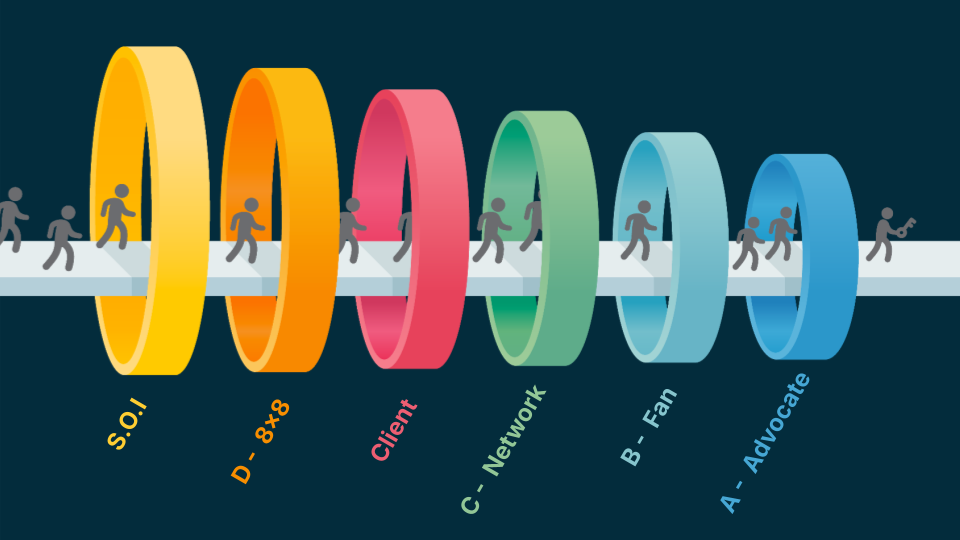
Your Contact Ladder: Where AI Fits at Every Level
Not everyone in your database needs the same treatment. That’s where most agents go wrong: they set up one automation sequence and blast everyone with it.
Your contacts exist in tiers. AI’s role changes at each tier.
Advocates: Your Raving Fans (20-30 people)
People who proactively refer you without being asked. They send you deals. They defend you when someone questions whether to use you.
AI’s role: Intelligence gathering. AI flags when an Advocate hasn’t been contacted in 60 days. AI tracks their life events: birthdays, work anniversaries, home anniversaries. AI tells you WHEN to reach out and gives you context for the conversation.
Your role: Personal calls. Handwritten notes. Face-to-face time. Coffee twice a year. These relationships are the foundation of your business. AI makes sure you never let one slip through the cracks.
What this looks like: AI sends you a notification: “Maria’s birthday is Thursday. She referred you 3 deals last year. Her daughter just started college (mentioned in August).” You call Maria on Thursday. You ask about her daughter. You’re the agent who remembers.
AI gave you the intel. You built the relationship.
Fans: Will Refer If Asked (60-100 people)
Past clients and sphere connections who’d help you if you stayed top-of-mind. With consistent contact, Fans become Advocates. Without it, they slide down.
AI’s role: Cadence management + content delivery. AI sends market updates between your personal touches. AI alerts you when a Fan engages with your content (opens 3+ emails, clicks a link). AI drafts a personalized follow-up for your review.
Your role: Personal touch every other month. When AI flags engagement, you call them within 24 hours. AI keeps you visible. You keep you meaningful.
Network: Your Sphere of Influence (100-200 people)
People who know you but haven’t worked with you yet. Neighbors, friends, former coworkers, event connections.
AI’s role: Visibility at scale. AI handles 3+ auto-flow touches per month: emails, social, market updates. AI nurtures these relationships at baseline without you spending hours on manual outreach.
Your role: Quarterly personal calls to a rotating group. Events that bring people together. Conversations that turn Network contacts into Fans.
New Contacts: Leads and Prospects
Everyone starts here. They don’t know you from anyone.
AI’s role: This is where AI shines brightest. Speed-to-lead responses at 3 AM. Automated qualification sequences. 8-in-8 drip campaigns (8 touches in 8 weeks). AI handles the volume so you’re not buried in manual follow-up for people who haven’t decided to work with you yet.
Your role: Once AI qualifies them and they show real buying signals, YOU take over. The human connection becomes the differentiator.
The Pattern
See it? AI does more at the bottom of the ladder and less at the top. New Contacts get heavy automation. Advocates get almost none, just intelligence and reminders.
That’s not anti-AI. That’s strategic AI. You’re deploying your most powerful tool where it creates the most value at every tier.
The agents who blast the same automation at every tier? They’re treating Advocate Maria (who referred three deals last year) the same as random Zillow lead Jeff who doesn’t remember requesting info.
Maria notices.
She doesn’t tell you she noticed. She just stops thinking of you first.
The 5-Test Framework: Where to Deploy AI
Before you automate any communication, run it through these five tests. This isn’t about whether to use AI. It’s about WHERE to point it.
Test 1: Relationship Tier
What tier is this contact on your Contact Ladder?
Advocates and Fans: AI handles reminders and intel. You handle communication.
Network and New Contacts: AI handles communication too. You handle exceptions.
Test 2: Task Type
Is this communication transactional or relational?
Transactional: AI handles it. Appointment confirmations, market reports, listing alerts, open house reminders.
Relational: You handle it. Check-ins, birthday calls, congratulations on life events, referral asks.
AI is perfect for transferring information. It’s terrible at building emotional connection.
Test 3: Last Real Conversation
When did you last have a real conversation with this person?
90+ days ago: Personal call required. AI can’t rebuild a lapsing relationship.
Within regular cadence: AI touches between personal contacts are fine.
Test 4: Expertise Required
Does this communication require your judgment, experience, or personal input?
Needs your brain: You handle it. Complex questions, emotional situations, strategy discussions.
Simple information: AI handles it. Home values, listing details, general market info.
Test 5: Referral Potential
Has this person referred you before, or could they realistically refer you?
High referral value: You handle communication. These people are your business.
Low referral potential: AI handles it.
The rule: If your contact fails even one test on the “you handle it” side, pick up the phone.
AI reminded you to call. Now call.
What AI Should Be Doing For You Right Now
If you’re not using AI for these things, you’re leaving money on the table.
1. Reminding you WHO to call and WHEN
AI flags contacts who haven’t been touched in 60+ days. AI reminds you when an Advocate’s birthday is coming up. AI identifies which Fans are at risk of sliding because you haven’t had a real conversation in three months.
Then YOU make the calls.
AI finds the gaps. You fill them.
2. Qualifying leads while you sleep
New inquiry at 2 AM? AI responds instantly, qualifies their timeline and budget, books a callback. You wake up to a warm lead instead of a missed opportunity.
This is where speed-to-lead matters: 78% of buyers work with the first agent who responds. Let AI win that race for you.
3. Drafting communications for your review
AI writes the first draft of your market update, your email follow-up, your listing description. You spend 5 minutes personalizing instead of 30 minutes staring at a blank page.
The 80/20 split: AI handles 80% of the grunt work. You add the 20% that makes it feel personal. That 20% (the details only you would know, the tone adjustment, the P.S. that shows you were paying attention) is what makes it land.
4. Handling appointment logistics
Confirmations, calendar management, rescheduling, reminders. Pure task execution. No emotional context needed. AI is perfect for this.
5. Compiling market data and reports
CMA compilations, market trends, neighborhood stats. AI pulls and formats the data. You add the commentary and send it with a personal note.
6. Managing your CRM
Data entry, contact updates, interaction logging, calendar syncing. AI saves you hours per week on admin. Use those hours to make personal calls to your Advocates.
7. Nurturing new leads at scale
8-in-8 campaigns, initial qualification, drip sequences for people who aren’t ready yet. AI handles the volume. You handle the humans who raise their hand.
This isn’t a small list. AI should be doing a LOT for you. The agents who thrive with AI aren’t using it less. They’re using it more, for the right things.
Red Flags You’re Pointing AI in the Wrong Direction
Stop and check yourself:
Your referral rate dropped 20%+ in the past year
You can’t name 10 Advocates off the top of your head
Your Advocates get the same automated emails as your Zillow leads
You feel “caught up” on database work but haven’t made a personal call in 3 weeks
Clients seem surprised when you call them personally
You’re spending $600+/month on AI tools but closing 8 deals/year
You saved 20 hours a week and spent zero of them on more personal outreach
One or two? Warning sign. Three or more? You’re using AI as a crutch, not an amplifier.
The fix isn’t less AI. It’s redirecting it.
If You’ve Been Using AI Wrong: How to Fix It
Maybe you’re reading this and recognizing yourself. You automated everything. Your referrals are down. Your Advocates are quiet.
You can fix this. Here’s how.
But first, picture this: You open your CRM and everything looks green. Every contact has been “touched” in the last 30 days. Then your best referral source from last year lists with someone else. You had no idea she was even thinking about moving. Your automation was running perfectly. You just hadn’t actually talked to her since closing.
That’s the gap. Here’s how to close it.
Step 1: Audit Your Contact Ladder
Open your CRM. List everyone who should be an Advocate based on past referrals or relationship strength.
When was the last time you had a real conversation (not an automated touch) with each of them?
If the answer is more than 90 days, they’ve probably slid down the ladder.
Step 2: Reconfigure AI by Tier
Set up separate workflows for each Contact Ladder tier:
Advocates: AI handles reminders and intel only. All communication is you.
Fans: AI handles market updates and engagement tracking. Personal touches are you.
Network: AI handles most outreach. You make quarterly personal calls.
New Contacts: AI handles qualification and nurture. You close.
Tag your Advocates in your CRM and create a rule: no automated relationship touches for this tier. AI reminds. You reach out.
Step 3: Redirect Your Saved Time
Those 20 hours AI saved you? Block time for what matters:
Monday 9-10 AM: Advocate calls
Wednesday 2-3 PM: Fan check-ins
Friday 10-11 AM: Network touches
Treat it like a showing. Non-negotiable.
AI saved you the time. Now invest it where the ROI is highest: your top relationships.
Step 4: Acknowledge the Gap
When you call Advocates you’ve neglected, be real:
“Hey Maria, I realized I’ve been leaning too hard on automation for the people who matter most. I wanted to personally reach out and see how you and the family are doing.”
People appreciate honesty. They don’t appreciate fake consistency.
Step 5: Measure Referrals, Not Efficiency
Stop measuring emails sent, sequences completed, and “touches logged.”
Start measuring:
Referrals received this quarter
Repeat clients this year
Active Advocates (people who’ve referred you in the past 6 months)
If referrals are going up, your AI strategy is working. If they’re going down, you’re pointing AI at the wrong things.
The Agent A vs Agent B Math
Let’s be explicit about the numbers.
Agent A: AI as Replacement
MetricValueAI tools + lead gen$5,300/month ($63,600/year)Deals per year8Referral rate10%GCI (8 deals x $10K avg)$80,000Net after marketing$16,400Hours/week60TrajectoryChasing leads, burning out
Agent B: AI as Amplifier
MetricValueAI tools + client appreciation$700/month ($8,400/year)Deals per year32Referral rate80%GCI (32 deals x $10K avg)$320,000Net after marketing$311,600Hours/week40TrajectoryReferrals compounding yearly
Agent B uses AI more than Agent A. He uses it for reminders, research, data, scheduling, lead qualification, drafts, CRM management. His AI stack is working constantly.
The difference is he never let AI replace the phone calls. He let AI make time for more of them.
Five years later: Agent A is still doing 8-10 deals, still spending $60K+ on marketing, still chasing leads. She’s tried three different AI platforms promising to “fix” her business. None did, because the problem was never the tools.
Agent B is doing 45+ deals per year, almost entirely from referrals. His Advocates have become superfans. They refer without being asked. His AI handles more of his admin than ever. His personal call list is longer than ever.
The better AI strategy won. Not less AI. Better AI.
Frequently Asked Questions
Can AI actually help build a referral-based real estate business?
Absolutely, when you use it strategically. AI handles CRM reminders, lead qualification, market research, scheduling, data entry, and content drafts. The time it saves you goes directly into more personal calls and relationship building. The best referral-based agents are heavy AI users. They just never let AI replace the human touchpoints that drive trust.
What should I automate vs keep human in real estate?
Automate: lead responses, appointment logistics, market reports, CRM data entry, initial lead qualification, content drafts. Keep human: calls to Advocates and Fans, personal check-ins, birthday wishes to top relationships, referral asks, emotional or complex client situations. The pattern: AI handles tasks, you handle trust.
How do I know if my AI strategy is working?
Track referrals, not efficiency. If your referral rate is going up, your AI strategy is working: you’re using the saved time to build relationships. If referrals are going down while your CRM stats look great, you’re pointing AI at the wrong things. Measure what matters: referrals received, repeat clients, active Advocates.
I’ve already automated too much. Can I recover my referral business?
Yes. Start by auditing your Contact Ladder: identify Advocates who’ve gone quiet. Call them personally. Acknowledge the gap honestly. Reconfigure your CRM so Advocates get AI-powered reminders but human-only communication. Block time for personal calls. Agents who commit to this recovery plan typically rebuild their referral rate within 6-12 months.
How much should I spend on AI tools?
Focus on a solid CRM with AI-powered reminders and lead management ($50-200/month). Skip the premium AI communication tools that promise to “handle your relationships.” The agents closing 30+ deals/year spend less on AI than the ones closing 8. They invest in tools that help them be more human at scale, not tools that replace the human work.
The Bottom Line
AI isn’t the enemy. AI isn’t even the risk.
The risk is using AI as an excuse to stop doing the work that built your business.
The best agents in real estate are using AI to become more human, not less. More personal calls. More remembered birthdays. More “how’s your mom doing?” check-ins. More showing up when it matters.
AI handles the tedious stuff (data entry, scheduling, market reports, lead qualification) so these agents can invest their time where it matters most: the relationships that generate 66% of their business.
NAR data is clear: 66% of sellers find their agent through a referral or past relationship. 82% of transactions come from referrals and repeat business. Your job is to be the agent people think of first.
AI can’t do that for you. But it can give you the time, the intel, and the systems to do it at a level you never could before.
That’s the play.
Use AI to do more human work, not less.
Agent A and Agent B both use AI. Agent A uses it to avoid the uncomfortable calls. Agent B uses it to make more of them.
One is burning out at 8 deals a year. The other is building an empire on referrals.
Pick a side.